
 ChatGPT
 Perplexity
 Claude
 Grok
Adaptive Learning: The Key To A More Responsive Training?
Adaptive learning is gaining importance as organizations seek better ways to train employees with diverse roles, backgrounds, and skill levels. Rather than giving everyone the same course in the same order, adaptive learning changes the experience based on what each person already knows and how they perform in training.
There is a clear need for more personalized learning. eLearning Industry's 2026 research shows that 65% of L&D buyers see personalization as one of the most valuable uses of AI in learning. But only 44% of vendors say they are building or planning similar features. The same research found that just 7.5% of buyers have fully integrated AI into their learning environments, while 45% plan to do so in the future.
This gap is important because adaptive learning is more than just an AI feature you can turn on. It is a learning strategy that relies on data, assessments, content structure, technology, and human judgment. When these parts work together, organizations can build more focused learning paths. If they do not, an adaptive learning platform might make things more complicated without helping performance.
What Is Adaptive Learning?
Adaptive learning uses data to adjust the learning experience based on what a person knows, how they behave, and how they perform.
An adaptive learning system can change several things, such as:
- The content the learner sees
- The order of topics
- How difficult the questions or activities are
- How much practice is needed
- The type of explanations or feedback given
- Whether the learner moves forward or gets extra help
What sets adaptive learning apart is not just personalization. It's the ongoing feedback loop between how the learner performs and what happens next in their learning.
For example, if an employee demonstrates mastery of a topic during an adaptive assessment, they might skip the basic modules and proceed directly to advanced practice. Another employee in the same program might get more basic content, extra examples, and more feedback.
Not all flexible or self-paced courses are truly adaptive eLearning. Just letting learners pick modules, get suggestions, or work at their own pace does not make a course adaptive. Real adaptive learning systems use information about the learner to decide how to change the experience.
Moreover, adaptive learning does not always need artificial intelligence. A simple adaptive learning model can use set rules to guide learners. More advanced systems that use AI might rely on algorithms, machine learning, knowledge graphs, or predictive analytics to make more complex choices.
How Does Adaptive Learning Work?
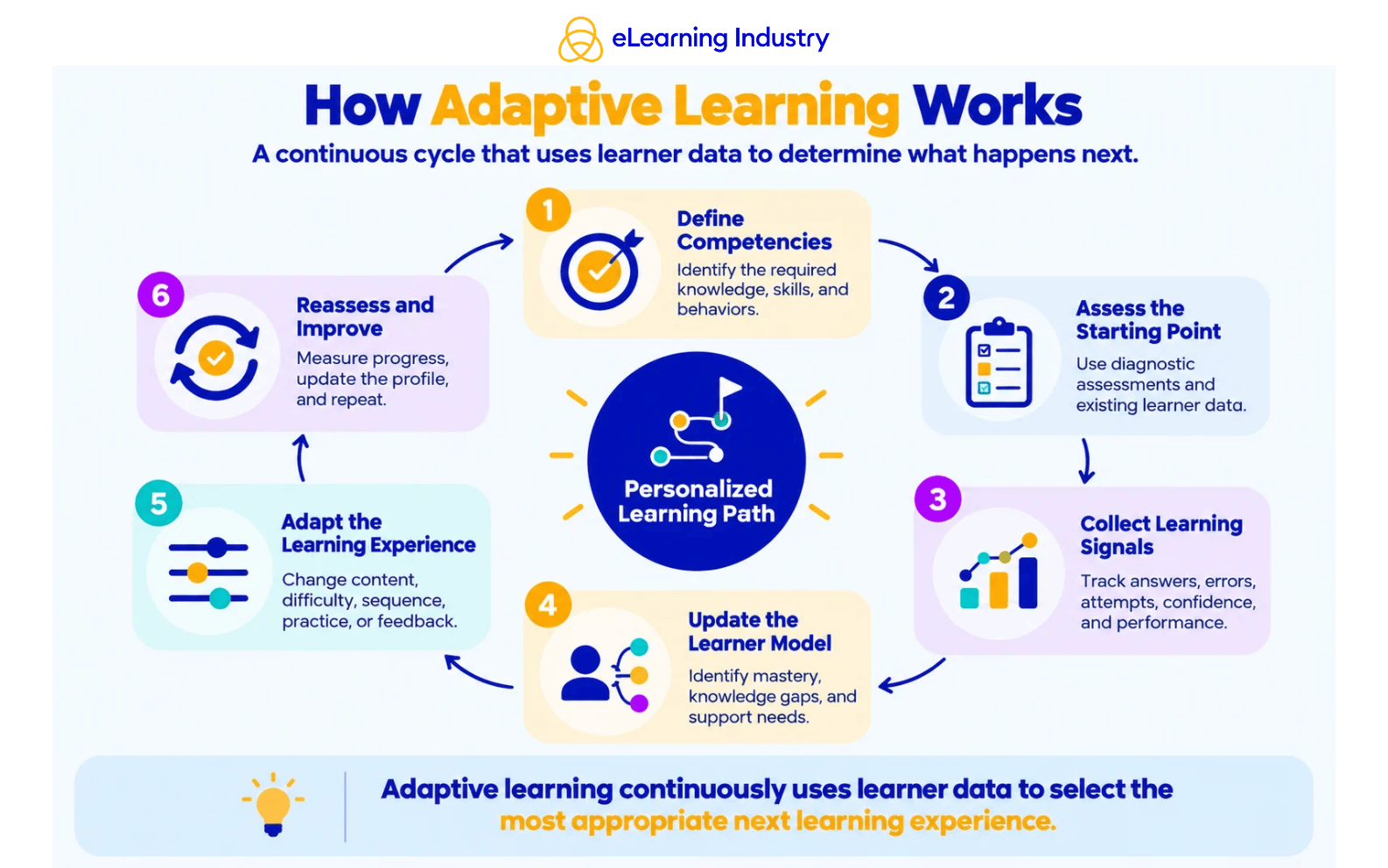
Adaptive learning collects information about a learner, interprets it, and then chooses the best next step for them. The system doesn't just personalize the course at the start and leave it at that. It keeps gathering learning signals and adjusts the experience as the learner moves forward.
The Adaptive Learning Cycle
Adaptive learning uses a repeating cycle instead of a fixed, step-by-step course structure.
1. Define the target competency
First, the organization determines what the learner needs to know or be able to do. This could be a set of knowledge, a workplace process, a technical skill, or a role-specific ability.
2. Establish the learner's starting point
A diagnostic test, skills profile, work history, past learning records, or performance data can help set an initial baseline.
3. Collect learning signals
The adaptive learning software looks at factors such as correct and incorrect answers, repeated mistakes, confidence ratings, number of tries, time spent, task performance, and demonstrated mastery.
4. Update the learner model
The system uses these signals to determine what the learner understands, where the gaps are, and which ideas might need more support.
5. Select the next experience
Depending on the adaptive learning algorithm or set of rules, the system changes the order of content, question difficulty, practice activities, explanations, or the amount of feedback given.
6. Reassess and repeat
New learner data updates the model again. This way, the personalized learning path keeps changing instead of staying the same.
The Core Components Of An Adaptive Learning System
Adaptive learning systems usually rely on four connected parts:
- Content or domain model: This defines the knowledge, skills, relationships, prerequisites, and learning goals within the subject.
- Learner model: This shows what the system currently thinks the learner knows, needs, or can do.
- Adaptation model: This decides which rules or algorithms pick the next activity, support, or resource.
- Delivery and analytics layer: This presents the learning experience and lets learners, instructors, and administrators see progress.
The technology can only make good decisions if these parts are well-designed. Even a smart algorithm will create weak learning paths if the content is poorly structured or the assessments are unreliable.
Adaptive Learning Vs. Personalized Learning
Adaptive learning and personalized learning are connected, but each focuses on a different part of the learning experience.
Personalized learning is a broad approach that adjusts learning to fit a person's goals, role, needs, experience, context, or performance. Adaptive learning is one way to provide this personalization in real time.
Factor |
Adaptive learning |
Personalized learning |
Meaning |
A mechanism that changes an experience using learner data. | A broader strategy for tailoring learning to an individual. |
Primary driver |
Demonstrated behavior, knowledge, and performance. | Goals, role, interests, needs, preferences, and performance. |
Timing |
Usually adjusts during the learning experience. | It may be designed before or during the experience. |
Decision-maker |
Technology, algorithms, or predefined rules. | The learner, instructor, organization, or technology. |
Example |
A system increases the difficulty of questions after demonstrating mastery. | An employee receives a leadership path aligned with career goals. |
A role-based curriculum can be personalized even if it is not adaptive. Similarly, recommending courses based on an employee's job title helps with personalization, but it does not always address real-time performance.
What Are The Benefits Of Adaptive Learning?
Adaptive learning works best when it addresses a clear learning need and uses well-designed content.
1. More Relevant Learning Experiences
Employees do not all have to complete the same material, as the approach focuses on real knowledge and skill gaps. Those who already know a topic can move ahead, while others get extra help. This reduces repetition but still maintains high standards.
2. Faster Time To Competency
Adaptive learning helps employees become competent faster. They can skip what they already know and focus on what they still need to learn. This is especially useful for onboarding, technical training, compliance, product education, and upskilling. Employees often start these programs with different backgrounds and experiences.
3. Better Visibility Into Knowledge Gaps
Traditional learning analytics usually track enrollment, attendance, and completion. Adaptive assessment gives deeper insights into misunderstandings, repeated mistakes, skill gaps, and mastery. L&D teams can use this data to improve content, focus coaching, and spot bigger skill gaps across teams or departments.
4. Personalized Learning At Scale
It is not practical to make a separate course for every employee. Adaptive learning technology lets people take different paths through the same content. However, Instructional Designers are still needed. Their work shifts more toward mapping skills, designing assessments, breaking content into modules, setting adaptation rules, and evaluating results.
5. More Timely Feedback
Adaptive learning can give feedback right away while someone is still working. Depending on the system, it might offer a new explanation, more practice, a worked example, or an easier problem before checking understanding again.
Research shows that how you design adaptive learning matters, though. A review of 30 studies found only a small overall effect for adaptive training, with big differences between methods. Adaptive difficulty worked best, followed by adaptive support and test-out options. So, organizations should not expect every type of adaptation to work the same way.
Adaptive Learning Examples In Corporate Training And Education
It's easier to evaluate adaptive learning when leaders look at how it changes the actual learning experience, not just the features of the platform.
Employee Onboarding
In corporate training, adaptive learning can help distinguish between experienced hires, career changers, and people starting their first professional job.
An experienced employee might demonstrate that they already know the basic policies and processes during an assessment. The system can then move them to role-specific scenarios. Someone with less experience may get more explanations and extra practice.
Compliance Training
Employees who already understand a requirement can move ahead faster this way, while those who miss important questions get extra help.
Still, organizations need to make sure the experience meets regulatory, documentation, and assessment requirements. Efficiency should never come at the cost of compliance.
Sales And Product Training
An adaptive learning platform can identify when a salesperson is struggling with product knowledge, customer discovery, objection handling, or a specific stage of the sales process. It can then assign relevant scenarios or practice, so the salesperson doesn't have to repeat the entire product curriculum.
Technical Upskilling
Adaptive learning systems work well in areas where task difficulty can increase incrementally. Programming, cybersecurity, data analysis, equipment operation, and software training can all use performance data to decide what comes next.
Customer And Partner Education
Adaptive learning software can tailor training to a user's role, product setup, technical skills, or past experience. For instance, a system administrator and a regular product user shouldn't have to follow the same learning path.
Higher And Professional Education
Adaptive learning in education can change practice, content order, and assessment difficulty for students who start a course with different backgrounds. Intelligent tutoring systems also use learner models and targeted support to help students with complex topics.
When Does Adaptive Learning Work Best, And Where Does It Fall Short?
Adaptive learning is most effective when an organization clearly defines its goals, tracks progress, and adjusts to different performance levels.
Adaptive learning is a stronger fit when:
- Learners have widely different starting points.
- Knowledge or competencies can be assessed.
- Content can be divided into reusable modules.
- Learners need repeated practice and feedback.
- Time to competency has operational value.
- Reliable learner data is available.
- The program serves a large population.
A simpler or human-led approach may be better when:
- The learner group is small and relatively similar.
- Success is subjective or difficult to measure.
- Learning depends on open exploration.
- The goal is collaboration, reflection, or cultural change.
- Motivation or management support is the primary issue.
- The data is incomplete or inappropriate for use.
- Coaching can address the need more effectively.
Limitations
Organizations should also consider several limitations:
- Content needs to be mapped, broken into modules, and tagged.
- Assessments should measure real knowledge or performance.
- Learner data might not always be accurate or complete.
- It can be complicated to connect adaptive learning with the LMS, LXP, HRIS, or skills platforms.
- Algorithms might reinforce bias or create inaccurate learner profiles.
- Employees might not understand why the system changed their learning path.
- Data privacy, security, consent, and retention require governance.
- Instructors need visibility and the ability to intervene.
- Ongoing maintenance is required as content and roles change.
Recent workplace evidence is promising but still emerging. In a 2026 field experiment with 2,574 employees, researchers found small positive effects on self-efficacy, transfer intention, and knowledge. However, they noted that the intervention used both adaptive routing and a different delivery system, so it was not possible to measure the effect of adaptivity alone.
How To Implement Adaptive Learning In 6 Steps
Adaptive learning works best when used for a specific performance goal, rather than rolled out across the whole organization without a clear purpose.
1. Start With The Performance Need
Figure out which skill, behavior, risk, or business result you want the program to improve. For example, your goal could be to shorten onboarding, boost product knowledge, cut down on mistakes, or help technical staff get certified. "Deliver personalized learning" is too vague.
2. Define Competencies And Mastery
Be clear about what learners need to know or do, and decide how you'll know they've mastered it. Depending on your goal, proof of mastery could be a test score, a completed simulation, a behavior observed at work, a completed task, or improved job performance.
3. Choose A Focused Pilot
Pick one role, group, program, or skill where learners start at different levels, and you can track results. A small pilot helps you compare adaptive learning to your current method, spot content gaps, and improve the model before expanding.
4. Modularize The Content
Divide the curriculum into smaller parts, each tied to a clear goal.
Each part may need details such as:
- The competency it supports.
- Its difficulty level.
- Required prerequisites.
- The misconception it addresses.
- When should it be recommended?
- Whether it provides instruction, practice, or assessment.
If you don't set up this structure, it's hard to sequence content in a flexible way.
5. Design The Adaptation Logic
Decide how the adaptive learning system should respond if a learner masters a topic, keeps struggling, partly understands, or needs help from a person. Also, set rules for when learners can question a decision, when instructors should step in, and if managers can change the suggested path.
6. Evaluate, Refine, And Scale
Compare your pilot to a solid baseline. Completion rates can help, but they shouldn't be your main way to measure success.
More informative metrics include:
- Time to competency.
- Assessment or mastery improvement.
- Reduction in repeated errors.
- Knowledge retention.
- Application on the job.
- Manager-observed performance.
- Learner confidence.
- Differences in outcomes across learner groups.
- Content, support, and delivery costs.
The goal isn't to show that adaptive learning works everywhere. It's to see if it gives better results for a specific group and purpose.
What Should You Look For In An Adaptive Learning Platform?
When evaluating adaptive learning technology, focus on instructional fit, transparency, integration, and measurable value. Don't just look at how many AI features it offers. Before selecting an adaptive learning platform, ask:
- What does the system adapt?
Find out if the system changes content, pacing, difficulty, sequencing, feedback, recommendations, or all of these. - Which learner signals does it use?
Don't settle for vague claims about personalization. Check if the platform uses assessment results, behavior, skill profiles, learning history, confidence ratings, or workplace data. - Can administrators understand its decisions?
L&D teams need to understand why the adaptive learning algorithm changed a learner's path. - Can people override the system?
Sometimes, learners, instructors, or administrators need to correct misconceptions or step in when a recommendation doesn't fit. - Can it use your existing content?
Check whether the adaptive learning software requires specialized content or can use your organization's existing materials. - How much configuration is required?
Ask about competency mapping, tagging, assessment design, content maintenance, and implementation support. - Does it integrate with the learning ecosystem?
Review its compatibility with the LMS, LXP, learning record store, HRIS, skills platform, identity systems, and reporting tools. - How does it manage risk?
Check how the platform handles data privacy, consent, security, accessibility, retention, bias testing, explainability, and accountability. - Can it connect learning to performance?
The platform should help your organization measure mastery, application, and business outcomes, not just report activity.
It's important to take a balanced approach, since buyers still consider AI features alongside basic needs. Research from eLearning Industry shows that usability, pricing, integration, trust, and measurable value are still key factors in learning technology decisions.
Conclusion
Adaptive learning is valuable when it helps an organization make better instructional choices for people with different needs. It can make training more focused, reduce unnecessary repetition, help identify knowledge gaps, and support personalized learning paths for many people. Still, it does not replace standard eLearning, facilitation, coaching, social learning, or workplace experience. The best adaptive learning strategies start with clear competencies, reliable assessments, modular content, responsible data use, and a clear performance problem to solve. And remember that technology should support the strategy, not drive it.


