




All About Immersive Gesture-Based Technical Training
Industries that rely on hands-on technical proficiency often struggle with the same challenges: access to equipment, safety risks, high training costs, and the logistics of bringing people and machinery together. Gesture-based training offers a compelling alternative. Using only a standard camera, learners can assemble mechanical components in a 3D environment with natural hand movements. This article explores the history and evolution of gesture-recognition technology, how a globe-valve assembly prototype was built, and why this emerging approach has the potential to reshape the future of Learning and Development.
The Current Landscape Of L&D And Why Innovation Matters
The core purpose of talent development has always been to help people build skills that align with organizational goals. ATD defines the field broadly, covering Instructional Design, performance improvement, learning technologies, and the evaluation of learning impact. In today's environment, however, many technical and industrial sectors face barriers that go far beyond traditional instructional challenges.
Learners don't always have easy access to real equipment, especially when machinery is costly or in constant use. Safety is another barrier because practicing on live equipment introduces risks that many organizations cannot take lightly. Even when equipment is available, geographic distribution creates complications. A workforce may be spread across regions, yet the training lab may be located in only one location. Consumables, maintenance costs, and inconsistent training conditions add another layer of complexity.
These realities highlight a crucial need for scalable, realistic, and safe ways to teach hands-on skills without relying on physical tools every time a learner needs practice.
A Short History Of Gesture Recognition
Gesture recognition has deep roots in human-computer interaction research. Early versions were far from simple. They relied on specialized gloves, infrared trackers, and dedicated sensors, making them impractical for broad adoption. Over time, rapid advances in computer vision and Deep Learning changed the landscape. Modern models can now track hand shapes, finger joints, and detailed movements using nothing more than a standard webcam.
This shift has made gesture-based interaction feel natural rather than experimental. Smartphones, tablets, and even low-powered laptops can now track hand movements in real time. These improvements mean gesture control is no longer a niche technology. It is accessible, scalable, and ready to be integrated into training environments. For learning professionals, this opens the door to new, intuitive types of practice that were once limited to VR labs or high-end hardware.
Market Size
According to the Global Market Insight, the market size for gesture-recognition technology was estimated at USD 19.8 billion in 2023, and it is projected to grow significantly over the coming years (with a projected growth rate of ~20% annually between 2024 and 2032).
Putting It Into Practice: A Gesture-Controlled Globe Valve Simulation
To explore what gesture-based training could actually look like, I built a working prototype that allows learners to assemble a globe valve in 3D space using nothing but their hands. No gloves. No controllers. Only a camera.
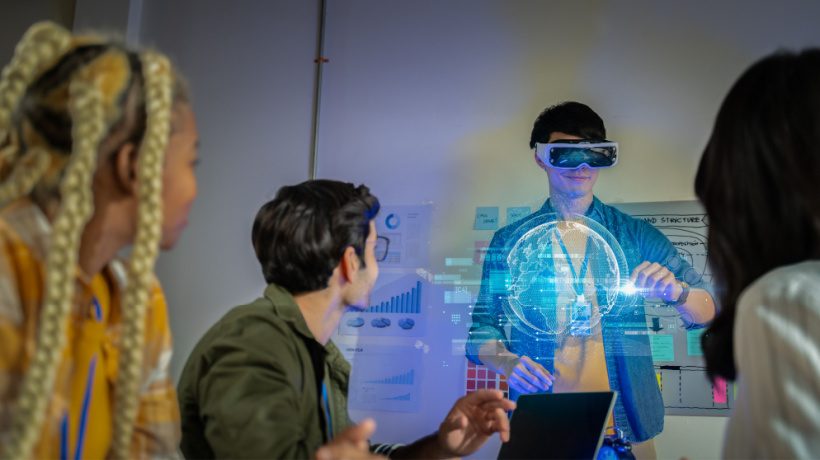
The system displays a disassembled valve on the screen. The learner uses both hands in different ways. The left hand moves and rotates the main body of the valve, almost like adjusting the workspace. The right hand is used to select, grab, rotate, and place individual components. When a part is positioned correctly, it clicks into place and confirms the action. If not, the system gives clear, immediate feedback to guide the correction. The entire activity is timed and scored, allowing learners to see their progress and compare performance across multiple attempts.
The moment the first part snapped into place felt almost surreal. It was intuitive, tactile, and surprisingly close to interacting with a real object floating in the air. [1]
Why Gesture-Based Training Matters For Learning And Development
Accessibility And Scalability
Because the system requires nothing more than a camera and 3D assets, it can run on laptops, tablets, and mobile devices. This makes it easy to deploy across global teams without needing a dedicated training lab.
Safety And Risk Reduction
Learners can practice mechanical assemblies and maintenance procedures without exposure to hazardous environments or high-risk equipment.
Cost Efficiency
Organizations can reduce wear and tear on real equipment and save the cost of materials and maintenance that physical training sessions often require.
Support For Muscle Memory And Embodied Learning
The hand motions used in the training mimic the actual motions needed in the real workplace, helping learners build spatial awareness and true motor skills.
Immediate And Consistent Feedback
The system validates actions instantly and provides objective performance metrics. This consistency is often harder to achieve in instructor-led sessions.
Just-In-Time Learning
Because the system is purely digital, learners can practice whenever they need to, whether during downtime, between shifts, or from home.
Designing Gesture-Based Learning That Feels Real
Creating a gesture-driven training experience requires thoughtful design choices. Gesture accuracy is one factor. The system needs to recognize different hand shapes, lighting conditions, and backgrounds. Ergonomics matter as well because gestures should feel natural and reduce fatigue. The logic behind snapping parts into place has to balance precision with forgiveness so that learners stay engaged rather than frustrated.
Performance plays an important role, too. Smooth, real-time interaction helps maintain immersion. Clear feedback is essential so learners know what to correct. And because learners may access the training from a variety of devices, 3D assets must be optimized to run efficiently across different platforms. When these pieces are aligned well, the learning experience becomes not only functional but also surprisingly enjoyable.
What This Could Mean For The Future Of Industrial Training
Gesture-based training has enormous potential across a wide range of scenarios. It can support mechanical assembly, maintenance workflows, inspection tasks, safety drills, and even medical training. It opens a new avenue for remote learning, enabling organizations to train global teams without relying on physical facilities.
This technology aligns with broader developments in the talent development field, especially the move toward accessible learning, digital transformation, and capability building at scale. For organizations trying to keep pace with rapid change, gesture-based simulations offer a way to deliver high-impact skill development without adding operational strain.
Challenges To Consider
No emerging technology is without its hurdles. Gesture-based systems can struggle in poor lighting or cluttered environments. User variations in hand shapes or movement styles can affect detection accuracy. Creating realistic assembly mechanics requires thoughtful calibration. And while realism is important, overcomplicating the experience can overwhelm new learners.
Despite these challenges, advancements in AI, visual computing, and hardware performance are quickly closing the gap. What once required specialized equipment can now be achieved with tools most learners already own.
Conclusion: A Promising Direction For L&D
The globe valve prototype is just one example, but it demonstrates something important. Gesture-based technical training is not a distant concept. It is a practical, functioning solution with immediate applications. For Learning and Development professionals, now is the ideal time to explore this space. Early pilots can help organizations experiment with new forms of hands-on learning that reduce risk, cut costs, and open the door to more immersive experiences.
As industries evolve, the way we train the workforce must evolve with them. Gesture-based training offers a meaningful step toward more intuitive, accessible, and future-ready learning.