



How L&D Professionals Learn About AI: How Fast Is Adoption?
How L&D professionals learn about AI is now a key issue as Artificial Intelligence changes the field of Learning and Development. AI used to be seen as a new technology, but today it shapes how organizations design training, personalize learning, and track business results. Because of this, learning about AI is no longer just for early adopters. It is now essential for anyone responsible for preparing the workforce for the future.
This change is highlighted in eLearning Industry's 2026 benchmark report, which includes insights from over 500 L&D buyers and learning technology vendors around the world. The report looks at how organizations judge AI-powered learning platforms, where vendors are putting their resources, and how buyers' needs are changing. Most importantly, it shows that while more organizations are starting to use AI, many are still working out how to use it well.
The report calls this difference the "AI expectation gap." Essentially, this means that vendors keep adding new AI features, but L&D buyers care more about whether AI actually improves learning, User Experience, and business results. As the report says, "AI is becoming an expected capability rather than a primary differentiator." To close this gap and help organizations use AI effectively, it is important to understand how L&D professionals learn about AI and ensure they have the right skills and knowledge.
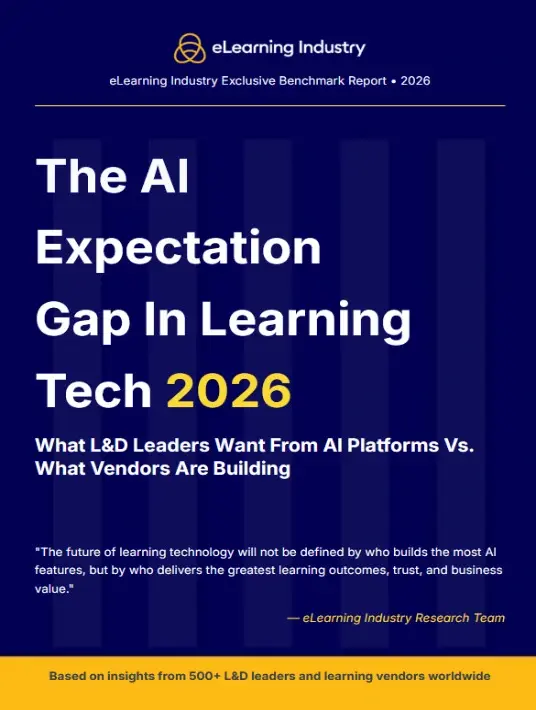
The AI Expectation Gap In Learning Tech 2026: What L&D Leaders Want From AI Platforms Vs. What Vendors Are Building
Why Learning AI Has Become A Priority For L&D Professionals
How L&D professionals learn about AI is getting more complicated, as AI is now seen as a strategic tool and, therefore, an important one. Since it helps create better learning experiences, improves efficiency, and drives business results, L&D professionals must know how to use it effectively.
Our report's findings reveal that:
- More than 8 in 10 L&D buyers consider AI an important factor when evaluating learning technology. Specifically, 37% describe AI as extremely important, while 45% say it is moderately important.
- In contrast, only 3% of respondents believe AI is not important when assessing learning platforms.
What does this show? That AI has become an expected capability rather than a differentiator.
However, the report also points out that organizations are moving past the hype around AI. L&D leaders are not just picking platforms with the most AI features, but want solutions that offer real, practical value. As the report says, "AI is rapidly becoming a competitive expectation. However, the data suggests L&D buyers are evaluating AI as part of a broader platform experience rather than treating it as a standalone purchasing determinant."
This change has big effects on how L&D professionals need to learn about AI. To choose the right vendors and make AI work in their organizations, they need more than just a basic understanding of generative AI tools. They need the skills to see how AI can improve learning results, fit with current systems, and make a real difference for the business. Learning about AI is now a must-have skill for anyone in L&D.
The AI Adoption Gap Is Driving The Need For Education
The way L&D professionals learn about AI is changing because most organizations are just starting to adopt it. Even though AI is now a top priority in the learning technology field, vendors and buyers are moving forward at very different rates.
Our recent benchmark report found that:
- 42% of learning technology vendors have fully integrated AI, but only 7.5% of L&D buyers say the same about their own environments.
- Another 45% of buyers are planning to adopt AI in the future, which shows that many organizations are still getting ready for AI instead of using it widely now. As the report says, "Vendors are building for future demand, while many L&D buyers are still determining where AI delivers meaningful value."
These results show why learning about AI is now so important in Learning and Development. Most L&D professionals are not learning AI because they already know it well, but because they are just starting to use it. They need clear, practical advice on how to choose AI-powered learning platforms, find useful ways to apply AI, and add it to their current workflows without making things harder for learners.
This shift also opens up a chance for more AI training for L&D professionals. As organizations move from just exploring AI to actually using it, learning how AI works and building confidence will be as important as buying new technology. To close the gap in adoption, organizations will need not just better AI tools, but also better education, support during implementation, and real-world examples that show clear business results.
How L&D Professionals Learn About AI
How L&D professionals learn about AI is changing as the technology grows. Instead of sticking to one source, they now use vendor resources, peer communities, formal training, and hands-on practice to see how AI can improve learning. According to our report, successful AI adoption relies not just on product innovation but also on "education, guidance, practical use cases, and implementation support." This shows a bigger shift in AI education for Learning and Development, with professionals focusing on how AI can create real business value, not just on its features.
Learning Directly From AI Platform Vendors
As AI becomes a bigger part of learning platforms, vendors are starting to act as educators. The report points out that many L&D buyers are still figuring out how to choose, use, and manage AI-powered learning tools, so vendor guidance is now a key part of learning about AI.
Webinars, product demos, onboarding sessions, and vendor guides help connect what a product can do with how it works in real situations. Instead of just showing off new AI features, vendors are expected to explain how these tools fit into current learning systems and help meet company goals.
This teaching role matters more now because L&D professionals want real answers, not just marketing. Our report shows that buyers care most about how to use AI, how it fits in, security, efficiency, and the results they can measure. This proves that organizations judge AI by the value it brings, not just because it is new.
Professional Communities And Peer Learning
Vendor resources are helpful, but AI learning goes beyond official materials. Many L&D professionals also use LinkedIn, online groups, professional associations, industry groups, and conferences to learn from peers who are already trying out AI.
These communities let people share experiences, talk about challenges, and find practical examples that might not be in vendor guides yet. Learning how another group used AI for onboarding, compliance, or personalized learning often gives more useful ideas than just reading about product features.
The report also says that buyers look for independent proof as well as vendor advice, which shows how important community learning is when adopting AI. As organizations move from trying out AI to actually using it, learning from peers helps professionals make better choices and avoid common mistakes.
Formal AI Training Programs
With AI training now a key focus for L&D professionals, structured learning is becoming more important. Online courses, certifications, workshops, and company training programs offer a clear way to build AI skills.
These programs, unlike informal learning, help professionals gain a stronger grasp of AI concepts, governance, prompt engineering, and responsible use. With this foundation, L&D teams can move past just experimenting and start building long-term AI strategies that fit their organization's goals.
The report highlights that adopting AI successfully takes both knowledge and technology. When L&D professionals build the right skills, they can better judge AI solutions and spot where these tools can truly improve learning and business results.
Hands-On Experimentation
One of the best ways for L&D professionals to learn about AI is by trying it themselves. Testing AI learning platforms, improving prompts, changing workflows, and starting pilot projects help teams see what works in their own setting.
This hands-on approach matches a key point from the report: L&D buyers care most about usability, trust, integration, and real results, not just new AI features. As the report says, "L&D buyers are evaluating AI through the lens of business value rather than novelty."
When organizations try out AI in real learning settings, they can find the most useful applications, improve their strategies, and build confidence before rolling out AI more widely. In the end, mixing structured learning with hands-on practice turns AI from a new technology into a practical tool that improves learning and shows real value.
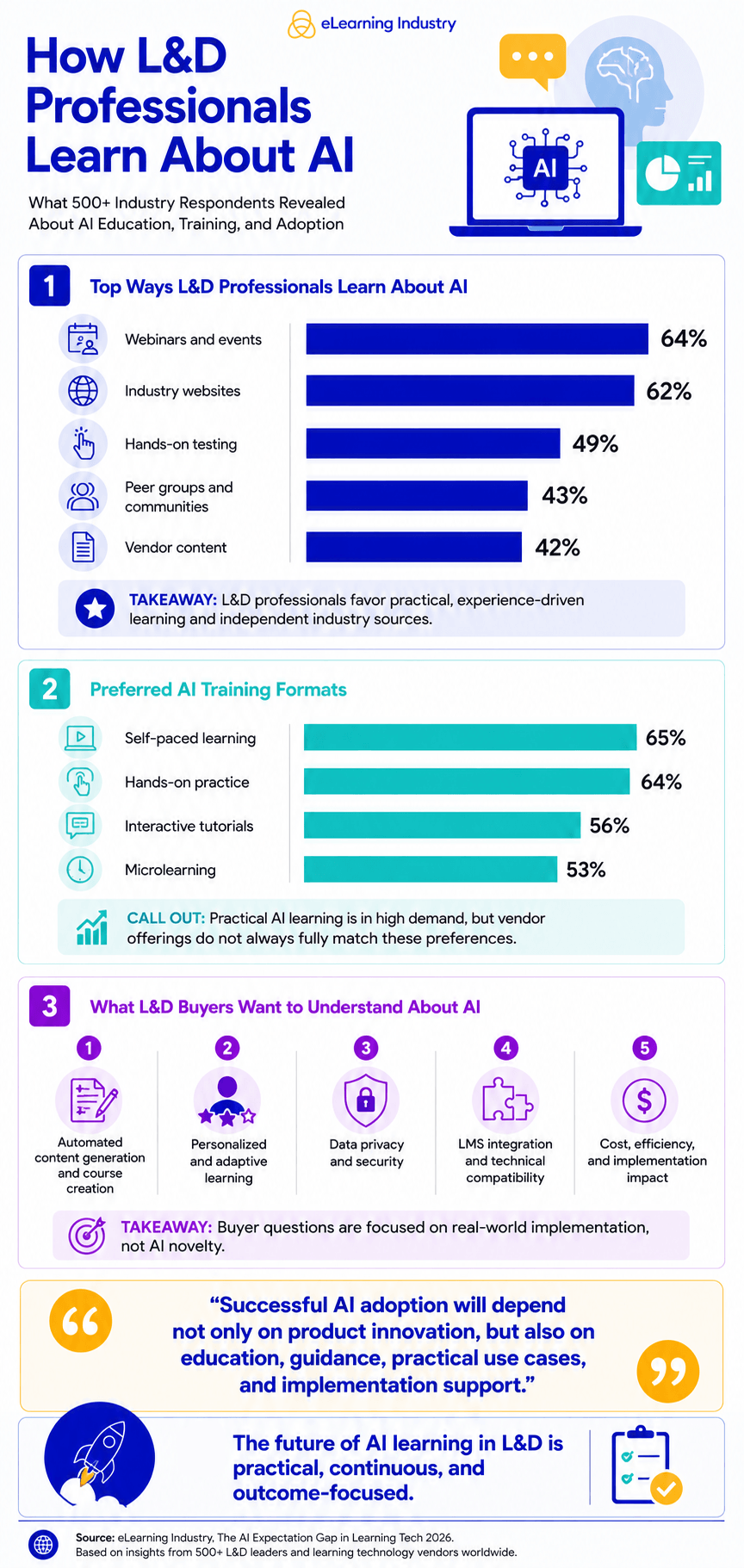
What L&D Professionals Want to Learn About AI
L&D professionals are now learning about AI mainly to solve real business problems, not just to keep up with new technology. Our benchmark report shows that they focus on knowledge that improves learning results, supports responsible AI use, and proves measurable value. The report also finds that buyers look at AI for its business impact, not just because it is new.
Personalization
Personalization is one of the most popular topics right now. According to our findings, personalized learning paths are the top AI feature for L&D buyers, with 65% choosing it as a main priority. However, vendors are investing more in AI-generated content, which shows a gap between what buyers want and what providers offer. Because of this, AI training for L&D professionals is now about building adaptive learning, giving personalized recommendations, and creating learner journeys that fit each person's needs instead of using the same training for everyone.
Responsible AI
Responsible AI is also a key learning focus. As more organizations use AI, professionals want to learn about AI governance, transparency, privacy, explainability, and ethics. These areas are important to make sure AI is used in line with company values. The report points out that "competitive advantage is shifting from AI features to AI trust" and that "trust is emerging as the next competitive battleground." For L&D, building trust in AI is just as important as knowing what it can do.
Measuring Business Results
L&D professionals are also learning how to measure business results, not just whether AI is being used. Organizations now expect AI projects to boost productivity, learner engagement, performance, and Return On Investment. Since buyers care most about User Experience, integration, trust, and measurable results, and not just AI features, this shows that successful AI training is about getting real business value, not just having more AI tools.
Conclusion
It is becoming more important for L&D professionals to learn about AI as it becomes a regular part of learning technology, not just a new trend. Adopting AI successfully takes more than just having new tools. It also needs ongoing education that focuses on practical use, responsible AI practices, building trust, and achieving clear business results. As organizations move past the trial stage, investing in AI skills and continuous learning can help close the gap between what buyers expect and what vendors deliver. In the end, companies that focus on both AI education and technology will be better prepared to improve learning, create business value, and get their teams ready for the future.