

 ChatGPT
 Perplexity
 Claude
 Grok
Grok
Writing Faster Is About More Than Speed
Learning how to write faster is not just about increasing the speed of your handwriting or typing. For professionals, being able to write quickly helps you capture ideas in workshops, take better notes in training, document meetings, create learning materials, write reports, and produce digital content more efficiently.
Effective writing speed means you can capture, organize, and share information quickly without losing accuracy, understanding, or clear handwriting. Writing faster should help you work better, not leave you with messy notes or confusing content.
There are two ways to get better at writing faster. Physical writing speed is about writing by hand more quickly, whether you use print or cursive. Cognitive writing speed is about organizing your ideas, structuring information, and drafting content more smoothly. Working on both helps professionals write quickly while keeping their work clear and high-quality.
How To Write Faster: Why Speed Matters For Learning And Knowledge
Writing speed is important in learning and knowledge work because it affects how well people can capture, process, and use information. In courses, meetings, workshops, or brainstorming sessions, professionals often have to listen, think, and write all at once. If handwriting is too slow, key ideas might be missed before they are written down. But writing too quickly can also make it harder to focus if you are just trying to keep up.
This is why writing as fast as possible is not usually the goal. What matters more is having a speed that works well for you. A good writer can capture the main points without losing meaning, accuracy, or readability. If someone writes quickly but cannot understand their notes later, they have not really improved.
For Instructional Designers, trainers, L&D teams, and other knowledge workers, being able to write quickly helps with tasks like taking notes on learners, writing workshop notes, making course outlines, storyboards, reports, and other documents. Writing faster can also give you more time to reflect, which is important for remembering and understanding what you learn.
In the end, writing at the right speed is about making things easier. Writing quickly should help professionals capture ideas, organize information, and turn what they know into useful results more easily.
How To Write Faster: 10 Techniques That Actually Help
Learning how to write faster is not just about hurrying. It is about streamlining the writing process. Whether you are taking notes, creating training materials, documenting meetings, or drafting professional content, you can write faster by choosing what and how to capture information. The aim is to write quickly while keeping your work clear, accurate, and easy to read.
1. Decide What You Need To Capture Before You Start
Before you start writing, think about whether you need to write down everything or just the key points. In most professional settings, you do not need to take word-for-word notes. Instead, figure out why you are writing. Are you recording decisions, capturing insights, documenting actions, or summarizing a discussion? Knowing your goal helps you focus on what matters and write faster.
2. Stop Trying To Write Every Word
A simple way to write faster is to stop trying to write down everything you hear. Focus on the main ideas, important terms, decisions, examples, and how concepts connect. For example, in a training session, writing down the main point and one example is usually more helpful than trying to copy every word the speaker says.
3. Develop A Consistent Shorthand System
Using a simple shorthand system can help you write much faster. Try using abbreviations, arrows, symbols, and shorter words for things you write often. Be sure to use the same shortcuts each time, so your notes stay easy to read. The best system is not always the shortest, but the one you can use and understand without thinking.
4. Reduce Unnecessary Pen Movement
When writing by hand, how you form your letters makes a difference. Big loops, lifting your pen too much, or making letters too fancy can slow you down. Try to use smaller, simple movements that still keep your writing clear. Improving how you move your hand is usually better for speed than just trying to write faster.
5. Relax Your Grip
If you grip your pen too tightly, your hand and fingers can get tired and stiff. This can slow you down and make writing harder. Holding your pen more loosely helps your hand move easily, which is especially helpful when you need to write for a long time, like during workshops or conferences.
6. Prioritize Rhythm Over Maximum Speed
If you want to write faster, do not focus only on speed. Keeping a steady rhythm usually works better. Trying to write too quickly can make your handwriting messy, cause you to miss things, or make you tired. A steady pace helps you write faster for longer and stay in control.
7. Separate Drafting From Editing
When writing on a computer or for work, editing as you go can slow you down. If you try to make every sentence perfect right away, it interrupts your flow. Instead, finish a rough draft first, then edit later. This method works well for creating scripts, learning materials, guides, or reports. By keeping writing and editing separate, you can write faster without losing quality.
8. Use Templates And Repeatable Structures
You do not have to start every document from scratch. Using templates can save time by removing many small decisions. For example, you can use set formats for learning objectives, course outlines, storyboards, questions, reports, and training plans. When you already have a structure, you can focus more on the content.
9. Practice With Timed Writing Exercises
To see real progress, try adding speed writing exercises to your routine. Write or take notes for a set time, then check how much you wrote and how clear it is. This gives you a starting point to track your improvement. It also lets you see your progress clearly, instead of just guessing.
10. Increase Speed Gradually
Finally, do not try to double your writing speed all at once. Improving slowly helps you keep your writing clear and accurate. Try going a little faster, see how it goes, and adjust as needed. In the end, writing faster is about finding the best speed that still lets your writing do its job.
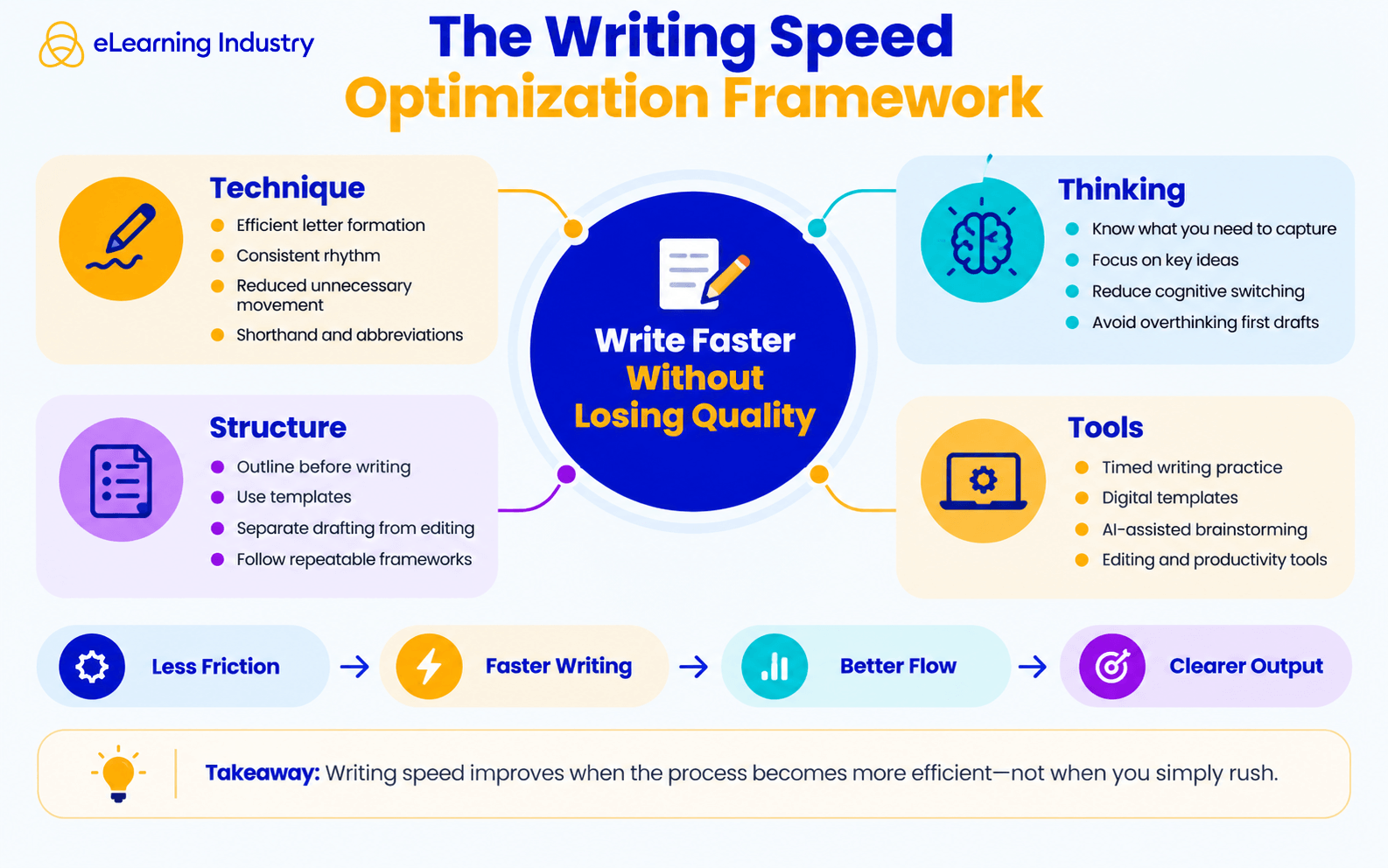
How To Write Faster By Hand Without Losing Legibility
Learning how to write faster by hand is not about pushing your pen harder, but about making your movements more efficient. Whether you are taking notes in a workshop, jotting down ideas in a meeting, or recording what you learn, quick handwriting is only useful if you can read it later.
Begin by holding your pen comfortably and sitting with good posture. Too much tension can slow you down and make your hand tired. Try to keep your letters and spacing even. To write faster and more neatly, use simpler letter shapes and lift your pen less often. Just make sure not to squeeze your words together so much that they become hard to read.
Practice is important too. Rather than just writing single letters over and over, focus on common letter pairs, words, and phrases. This helps you develop smoother movements for faster writing. For the best results, practice with passages that are similar to the notes you usually take in meetings, classes, or presentations.
As you practice writing faster, slowly pick up your speed and pay attention to when your writing starts to get hard to read. It is more important to keep your handwriting clear than to write as fast as possible.
Ultimately, the best speed for handwriting is the fastest pace at which both you and someone else can easily read what you wrote.
Fast Writing Practice: Exercises To Increase Your Writing Speed
The best way to improve your writing speed is to practice in a structured and measurable way. Instead of aiming for the fastest handwriting right away, try simple speed writing exercises to build fluency while keeping your writing clear. The aim is to get faster but still make notes that are helpful for learning, reflection, and work.
Exercise 1: Establish Your Baseline
Begin by writing as you normally would for five minutes on a topic you know well. Count how many words you wrote and figure out your words per minute. This gives you a clear starting point and helps you track your progress.
Exercise 2: Copy For Speed
Pick a short passage related to your work or studies and copy it by hand. Try to keep a steady pace instead of hurrying. When you finish, check your writing for spacing, consistency, and how easy it is to read. Good practice should help you write faster without making your notes hard to understand.
Exercise 3: Listen And Summarize
Listen to a short part of a webinar, training video, or presentation and write down just the main ideas. This helps you get faster at writing and better at picking out important information. Rather than writing every sentence, focus on the key points, actions, and conclusions.
Exercise 4: Increase Speed Incrementally
After you know your starting speed, try to write a little faster each time you practice. Making small improvements is easier to keep up with than trying to get as fast as possible right away. Going slowly also helps you stay accurate and in control.
Exercise 5: Test Your Notes Later
Later, look at your notes again after a few hours or the next day. Are they still easy to understand? This checks if your notes are useful, which matters as much as speed. If you can't read your notes later, the practice hasn't worked. In the end, getting faster at writing means finding a balance between speed, clear writing, and making sure your notes are helpful in the long run.
How To Write Blog Posts And Professional Content Faster
If you work in Instructional Design, training, L&D, HR, or create learning content, writing quickly usually isn't about typing faster. It's more about making it easier to think, organize, and decide what to say. If you want to write blog posts or work documents faster, your process is just as important as your typing speed.
Outline Before You Draft
Begin by deciding what your content should achieve and how your ideas will connect. If you try to plan and write at the same time, it can slow you down. Creating a simple outline helps you stay focused and move smoothly from one section to another.
Draft First, Edit Second
A simple way to write faster is to avoid editing each sentence as you go. First, get your main ideas on the page. Later, you can go back to make your writing clearer and more accurate. Keeping drafting and editing separate helps you keep up your pace.
Work From Reusable Frameworks
Using the same structure each time can save a lot of time. L&D teams can rely on templates for things like course descriptions, learning objectives, assessments, guides, reports, and blog posts. This way, you spend less time on setup and more on the actual content.
Research Before Opening The Draft
Jumping back and forth between research and writing can break your focus. Collect your key facts, examples, and sources before you start. That way, you can write without stopping to look things up.
Use AI As An Accelerator, Not A Substitute For Expertise
AI is useful for brainstorming, organizing information, summarizing sources, and making a first round of edits. But working faster shouldn't mean skipping human judgment. You still need your expertise, context, fact-checking, and editorial choices. Use AI to handle repetitive tasks so you can focus on the decisions that really need your skills.
Conclusion
Writing faster isn't just about hurrying, but about making the process smoother. In the end, writing quickly should help you achieve your purpose, not get in the way. The aim isn't to be the fastest writer, but to share useful ideas in less time while remaining clear and accurate and meeting your audience's expectations.
![Smarter, Faster, Better: 25 AI Tools For L&D That Make Learning Stick [eBook Launch]](https://cdn.elearningindustry.com/wp-content/uploads/2025/08/Smarter-Faster-Better-25-AI-Tools-For-Learning-Development.png)