 ChatGPT
 Perplexity
 Claude
 Grok
Grok
All About Interpersonal Learning
Interpersonal learning is increasingly recognized as a critical capability for modern organizations that rely on collaboration, knowledge sharing, and strong team dynamics. At its core, interpersonal learning is about how individuals develop skills and understanding through interaction with others, whether that happens in structured training, informal conversations, or real-time problem solving at work.
For Instructional Designers and L&D leaders, understanding the definition of interpersonal learning is no longer optional. As workplaces shift toward cross-functional teams and hybrid environments, the ability to design for social interaction becomes a strategic advantage. This is especially relevant when supporting an interpersonal learner, someone who processes information best through discussion, feedback, and shared experiences.
But what is an interpersonal learner in practice, and how do their needs translate into effective learning design? To answer that, it is essential to explore the characteristics of interpersonal learning and interpersonal intelligence. In this article, we'll show you how interpersonal learners learn best and ultimately help you design learning experiences that drive engagement and performance.
What Is Interpersonal Learning?
Interpersonal learning is the process of gaining knowledge, skills, and behaviors through interaction with others, including collaboration, discussion, feedback, and shared experiences.
But what is interpersonal learning in the workplace? It is learning that happens between people rather than in isolation. Employees gain new skills by sharing ideas, observing their colleagues, getting feedback, and solving problems together. This type of learning is important for modern organizations, where teamwork and communication are essential for success.
Unlike individual learning, which focuses on personal reflection and studying alone, interpersonal learning is social. It depends on discussions, group interactions, and immediate feedback. It also differs from self-paced eLearning, where people usually just read or watch content without engaging. While online courses can help with learning, they often don't provide the interaction needed to develop skills like empathy, active listening, and influence. For Instructional Designers, this difference is important. When designing for interpersonal learning, it's necessary to create chances for discussion, teamwork, and feedback, not just to present information.
Why Interpersonal Learning Matters In Modern Workplaces
As work shifts toward team-based structures and cross-functional collaboration, employees are expected to learn continuously from one another, not just from formal training. This is what makes interpersonal learning so important.
Breaks Down Siloed Knowledge
In hybrid environments, this becomes even more critical. Without intentional interaction, knowledge stays siloed. Interpersonal learning helps bridge that gap by enabling people to exchange insights, give feedback, and solve problems together in real time.
Fosters Psychological Safety
At its core, what is interpersonal learning if not the ability to learn through relationships? This is where psychological safety plays a key role. When employees feel safe to speak, challenge ideas, and share experiences, learning accelerates across the organization.
Supports Knowledge Transfer
It also directly supports knowledge transfer. High-performing teams rely on informal learning moments, such as conversations, peer coaching, and shared reflection. This is how expertise scales.
What Is An Interpersonal Learner?
You may find yourself asking, "What is an interpersonal learner?" An interpersonal learner is someone who learns most effectively through interaction with others. Specifically, these people tend to learn best through dialogue. They understand ideas more deeply when they can talk them through, ask questions, and hear different perspectives. Instead of passively consuming information, they process it socially by exchanging insights, observing others, and participating in group activities. Another defining trait is their need for feedback. They often seek validation or input from peers, mentors, or facilitators to refine their understanding and improve performance.
In workplace learning environments, interpersonal learners thrive in collaborative cultures where knowledge is shared openly. They perform particularly well in coaching-driven environments that prioritize feedback, mentoring, and continuous interaction.
Characteristics Of Interpersonal Intelligence
Understanding the characteristics of interpersonal intelligence helps Instructional Designers and L&D leaders create learning experiences that reflect how people actually learn at work. At its core, these interpersonal intelligence characteristics describe how individuals process information through interaction, collaboration, and social feedback.
Core Traits
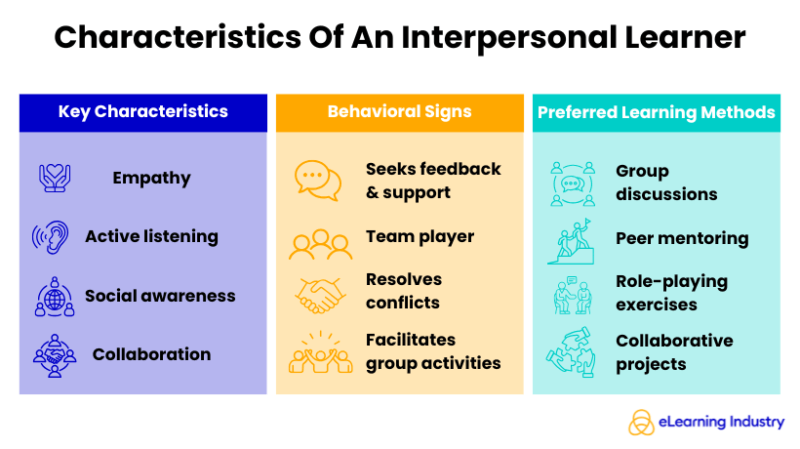
- Empathy: People with strong interpersonal intelligence tend to show high levels of empathy, allowing them to understand others' perspectives and emotions.
- Active listening: They also practice active listening, not just hearing but interpreting meaning and intent.
- Social awareness: Social awareness enables them to read group dynamics and adapt their behavior accordingly, while communication fluency helps them express ideas clearly and build alignment across teams.
Behaviors In The Workplace
In practice, these traits translate into visible behaviors. Some of them are:
- Team contribution: Interpersonal learners are often strong team contributors, actively engaging in discussions and knowledge sharing.
- Facilitation: They act as natural facilitators, guiding conversations and ensuring all voices are heard.
- Conflict navigation: They are also effective conflict navigators, using communication and empathy to resolve tensions and maintain collaboration.
How Do Interpersonal Learners Learn Best?
Understanding how interpersonal learners learn best is essential for designing effective workplace learning experiences. An interpersonal learner processes information through interaction, meaning learning is most effective when it involves dialogue, collaboration, and shared problem solving.
Preferred Learning Methods
To describe ways in which an interpersonal learner prefers to learn, it is important to focus on socially driven formats:
- Group discussions: These allow learners to exchange perspectives, challenge assumptions, and co-create understanding.
- Peer learning: Learning alongside colleagues encourages knowledge sharing and builds trust across teams.
- Role-playing: Simulated scenarios help learners practice communication, negotiation, and decision making in a safe environment.
- Mentorship and coaching: Guided conversations provide personalized feedback and accelerate skill development.
These methods align with the natural strengths of an interpersonal learner, who benefits from real-time interaction and social feedback.
Less Effective Formats
Not all learning environments support interpersonal learners equally. For example:
- Passive eLearning modules: One-way content consumption limits opportunities for discussion and reflection.
- Fully asynchronous training: While flexible, it often lacks the immediacy of feedback and human connection that interpersonal learners need.
Without interaction, engagement and knowledge retention can decline significantly.
Interpersonal Learning In Group Therapy: What L&D Can Learn
Instructional Designers can draw inspiration from how interpersonal learning works in group therapy sessions to design their learning experiences. Interpersonal learning in group therapy refers to how individuals develop self-awareness and new behaviors through interaction with others. This includes receiving feedback, reflecting on experiences, and observing how others think and respond.
For L&D teams, the example is clear. Structured peer feedback sessions can act like therapy, helping employees see how their actions affect others. Additionally, retrospectives and team reflection exercises create opportunities for shared learning, allowing individuals to discuss their outcomes together rather than alone. These methods work especially well for interpersonal learners, who gain from conversation and social interactions.
The key insight is that behavior change happens faster in social environments. When learners see patterns in others and receive real-time feedback, they adjust more quickly. This answers a critical question: how do interpersonal learners learn best? Through interaction, observation, and reflection, not passive consumption. For organizations, this means designing learning experiences that prioritize connection over content.
How Instructional Designers Can Apply Interpersonal Learning
For Instructional Designers, using interpersonal learning means creating experiences where interaction helps people understand. It's not just about adding group activities.
Design Principles
- Social-first learning design: Instead of building content and adding interaction later, begin by asking, "Where will learners engage with each other?"
- Collaborative problem solving: Real learning occurs when individuals work together to analyze scenarios, challenge assumptions, and co-create solutions.
- Feedback opportunities: Peer feedback, facilitator input, and reflection loops are essential. These elements reinforce the interpersonal learning definition, where growth is shaped by social exchange.
Practical Use Cases
- Leadership development programs: Interpersonal learning enables leaders to practice communication, empathy, and decision making in realistic group settings.
- Onboarding: There, it accelerates integration. New hires learn faster when they share experiences and build relationships early.
- Peer mentoring systems: They create structured opportunities for knowledge exchange, aligning with the characteristics of interpersonal intelligence, such as empathy and active listening.
Tools
- Cohort-based learning models that encourage ongoing interaction.
- Discussion-driven LMS features like forums, peer reviews, and group assignments to sustain engagement.
- Workshops and simulations that allow learners to practice interpersonal skills in safe, structured environments.
Common Mistakes When Designing For Interpersonal Learning
Even experienced Instructional Designers can misapply interpersonal learning if they treat it as informal or self-organizing.
Confusing Group Work With Collaboration
Simply placing learners in teams does not guarantee meaningful interaction or knowledge exchange. True interpersonal learning requires shared goals, defined roles, and purposeful dialogue.
Lack Of Structure In Discussions
While interpersonal learners benefit from conversation, unstructured discussions often lead to surface-level engagement. To support them, designers must guide conversations with prompts, scenarios, or facilitation frameworks.
Absence Of Feedback Loops
Without timely peer or facilitator input, learners miss opportunities to reflect and improve.
Overlooking Quieter Participants
When designing for someone who is an interpersonal learner, it is important to recognize diversity within this group. Not all interpersonal learners are outspoken. Ignoring introverted learners can limit inclusion and reduce the effectiveness of the learning experience.
Conclusion
Interpersonal learning is more than just a learning preference; it's an opportunity that organizations can leverage to strengthen collaboration, innovation, and performance. When companies design learning experiences that prioritize interaction, discussion, and peer feedback, they unlock their teams' potential to learn faster and retain knowledge more effectively. By fostering environments where interpersonal learners can thrive, organizations not only enhance individual growth but also build stronger, more adaptive teams. Therefore, in today's dynamic workplace, investing in this approach is a practical way to drive engagement, improve outcomes, and make gaining knowledge a core part of organizational success.