


Learning Mindset: Definition, Examples, And How To Build It In The Age Of AI
A learning mindset is becoming a core capability for Instructional Designers working in fast-changing environments. Previously, workplace learning was mostly about gaining knowledge. Now, adaptability is more important, and being able to learn, unlearn, and relearn is valued over just having static expertise.
Because of these changes, the idea of a learning mindset is becoming more popular in L&D and HR. As AI changes jobs and workflows, skills become outdated more quickly. Therefore, Instructional Designers are now expected not only to create content but to design experiences that foster continuous learning and support long-term capability building. On top of that, organizations also need to focus on developing a learning mindset in the age of AI, not just for individuals, but throughout their systems, culture, and learning design.
This article explains what a learning mindset is, compares it with related frameworks, and provides practical examples. It also outlines how L&D teams can embed a lifelong learning mindset into workplace learning strategies. Let's dive right into it.
What Is A Learning Mindset?
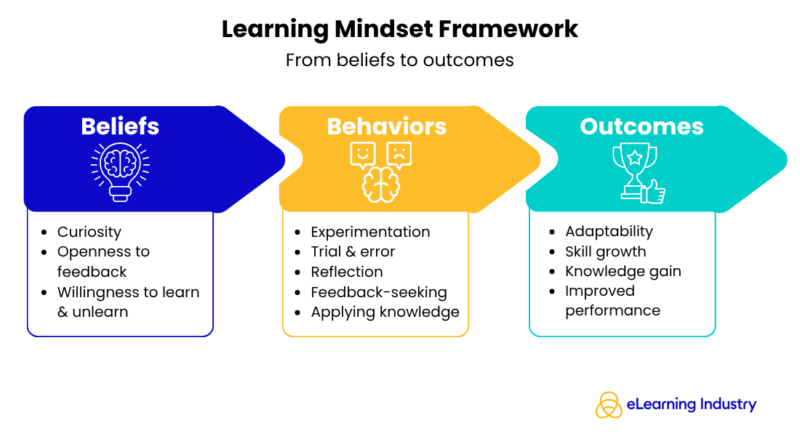
A learning mindset is the ability and willingness to keep learning, unlearning, and using new knowledge as things change. It involves staying open to new ideas, adapting when things are uncertain, and taking action to learn so you can keep up with changes at work. In L&D terms, it is a set of observable behaviors that shape how individuals engage with learning experiences over time.
A strong learning mindset is more than just curiosity. It means being open to new knowledge, ready to let go of old habits, and able to adapt quickly when things change. This matters most when people face uncertainty, like new tools, changing roles, or AI-driven workflows. Someone with a true learner mindset puts this into practice by asking good questions, trying new methods, and thinking about what works.
Knowing what a learning mindset is matters a lot for workplace learning. It affects how engaged people are, how they build skills, and how well learning leads to better performance. Without a learning mindset, even the best programs may not create real change.
Learning Mindset Vs. Growth Mindset Vs. Learning Agility
In workplace learning, people often use these three concepts interchangeably, but each one has a different purpose.
- A growth mindset is belief-based. It reflects the idea that abilities can improve through effort and practice. This idea is important, but by itself, it does not always lead to action.
- A learning mindset, on the other hand, is behavior-driven. It describes how individuals approach learning in real situations, and it's usually by seeking feedback, experimenting, and adapting continuously. When we define what a learning mindset is, we move beyond belief into observable habits. This is why the distinction between a learning and a growth mindset matters for Instructional Design and training outcomes.
- Learning agility takes things a step further. It is the ability to apply what you have learned quickly, especially in new, complex, or stressful situations. When comparing the growth mindset and learning agility, the key difference is in action: one is about believing you can learn, while the other is about showing it when it matters most.
Key Differences
Concept |
Focus |
Behavior |
Workplace Impact |
| Growth Mindset | Beliefs about ability | Openness to improvement | Encourages effort |
| Learning Mindset | Learning behaviors | Feedback, experimentation | Drives a continuous learning mindset |
| Learning Agility | Application | Adapting in real time | Enables performance in change |
Why A Continuous Learning Mindset Is Important For Businesses
A continuous learning mindset has become a core business capability. Let's see why.
AI And Automation Reshape Roles
As AI and automation reshape how work gets done, roles evolve faster than job descriptions can keep up. The half-life of skills is shrinking, which means what employees know today may lose value much sooner than expected. In this environment, organizations need people who can learn, unlearn, and relearn continuously. A lifelong learning mindset enables that shift. Instead of relying on static expertise, teams can stay flexible and respond to change. This is especially important for L&D leaders and Instructional Designers, who now need to support ongoing skill development rather than just offer one-time training.
Changes In Business Operations
Organizations are also changing how they work. Many are moving to skills-based models, where what people can do matters more than their job titles. At the same time, companies are focusing on helping current employees learn new skills instead of hiring from outside. Both of these trends rely on having a strong learning mindset throughout the workforce.
Faster Adaptation
The benefits are clear. Organizations that encourage a lifelong learning mindset tend to adapt faster to change and recover more quickly from disruptions. They can also close skill gaps without slowing down their work. Not to mention that companies that focus on a continuous learning mindset often see better results, because employees can use new knowledge right away.
Better Retention And Innovation
Continuous learning also helps with retention and innovation. Companies that support a learning mindset are more likely to keep talented employees, because people feel their growth is valued. At the same time, a culture of learning encourages people to try new things, thereby fostering more innovation.
Developing A Learning Mindset In The Age Of AI
Speaking of how AI and automation reshape roles and change business operations, it's time to talk about developing a learning mindset in the age of AI. This is now essential for organizations that want to stay competitive, as AI can act as a helper that boosts productivity for many, but for others, it can feel like a threat and cause resistance. So, the main challenge for L&D leaders is not just getting people to use new tools but helping them adopt a new way of thinking. And for this, they need to develop a strong learning mindset; without one, even the best tools go unused. However, when professionals have a continuous learning mindset, they move from feeling afraid to trying new things. Instead of worrying about "Will AI replace me?" they start asking, "How can I use AI to make my work better?" This change in thinking is what helps organizations adapt and stay ahead.
What Changes With AI
AI is reshaping what it means to perform well at work. Now, having a learner's mindset means success depends on more than just what you know.
- From knowing → prompting: Instead of focusing on memorizing information, the real value now comes from asking good questions and knowing how to guide AI tools.
- From expertise → adaptability: Expertise is still important, but being able to learn, unlearn, and relearn quickly matters even more. This is how a growth mindset turns into real action.
- From static roles → evolving skill stacks: Roles are no longer fixed. A lifelong learning mindset enables professionals to continually build new skills as the workplace evolves.
Risks Of Not Developing A Learning Mindset In The Age Of AI
Organizations that fail to prioritize developing a learning mindset face clear risks:
- Skill stagnation: Employees may cling to old knowledge rather than keep up with new technology.
- AI avoidance: Fear can lead people to avoid using AI, reducing the return on AI investments.
- Reduced employability: People who do not keep learning may find it hard to stay relevant as roles change quickly.
Learning Mindset Examples In Workplace Learning
Understanding the learning mindset becomes easier when you see how it shows up in real work. Below are practical, scenario-based learner mindset examples that reflect everyday behaviors across roles. These examples move beyond theory and show what a continuous learning mindset looks like in action.
Example 1: Instructional Designer
An Instructional Designer working on a new onboarding program chooses to try an AI-powered LMS rather than rely solely on familiar software. Rather than aiming for perfection in the first version, they launch a pilot module to a small group of learners.
After launching the module, they collect feedback using surveys and usage data. They see that learners stop at a certain interaction point. Rather than defending the design, they update the module, make the interaction simpler, and test it again.
This is a strong learner mindset example because the designer sees the learning experience as something that can be changed and improved. It also highlights the difference between a learning mindset and a growth mindset: it is not just about believing in improvement but about acting on feedback and making changes regularly.
Example 2: Manager/Leader
A team leader introduces a new workflow tool to help everyone work more effectively together. Rather than requiring everyone to use it right away, they present it as a trial. The team is asked to try the tool for 2 weeks and provide feedback on what works and what does not.
During team meetings, the manager openly discusses their own challenges with the tool. If someone points out a problem, the manager listens and makes changes to improve the process.
This behavior demonstrates a continuous learning mindset at the leadership level. By normalizing trial and error, the manager creates psychological safety. This is important for building a learning culture, since people are more willing to try new things when mistakes are not punished.
Example 3: Employee/Learner
An employee transitioning into a new role notices they have little experience with data analysis. Rather than wait for formal training, they sign up for short online courses and begin using basic concepts in their daily work.
They regularly ask peers for feedback on their work and adjust their work based on that feedback. When they make mistakes, they document what went wrong and refine their approach.
This shows both a student mindset and a lifelong learning mindset. The employee takes charge of their own growth and demonstrates self-direction, both key parts of a learner mindset.
How Instructional Designers Can Build A Learning Mindset Into Programs
For Instructional Designers, building a learning mindset is not about adding more content but about shaping behavior. Traditional programs focus on completion rates and knowledge transfer. But a true learner mindset develops when people are encouraged to explore, reflect, and adapt over time. This shift, from content delivery to behavior design, is what drives real impact in workplace learning.
Design For Exploration, Not Completion
Linear courses often limit curiosity. To support a continuous learning mindset, programs should offer optional paths, branching scenarios, and self-directed choices. When learners can choose what to explore next, they begin to take ownership of their development. This is especially important when developing a learning mindset in the age of AI, where adaptability matters more than following a fixed path.
Embed Reflection Loops
A strong learning mindset definition includes the ability to think critically about one's own learning. Instructional Designers can support this by adding reflection prompts throughout the experience. Instead of asking only for correct answers, ask learners to evaluate their decisions, challenges, and assumptions. This approach strengthens growth-mindset learning by making it more intentional and self-aware.
Reward Learning Behaviors
Many organizations still focus solely on outcomes such as completion, scores, or certifications. However, a lifelong learning mindset is built when behaviors such as experimentation, feedback-seeking, and persistence are recognized and rewarded. So, Instructional Designers can design systems that highlight progress rather than just results. This shows that learning is a continuous process, not just a single event.
Create Safe-To-Fail Environments
Fear of failure can hold people back. To foster a student mindset at work, learners need room to try, fail, and improve. Simulations and scenario-based learning work well for this. They let learners test choices without real-world risks. This is because showing examples of how people adjust, try again, and improve helps build confidence and resilience.
Use AI Tools As Learning Partners
AI is changing how people learn, but tools by themselves are not enough. Instructional Designers should treat AI as a partner in learning. Therefore, encourage learners to experiment, ask questions, and improve their thinking with AI tools. This helps build a learning mindset that is flexible and ready for the future, rather than relying solely on fixed knowledge.
Conclusion
Having a learning mindset is now a key advantage for organizations that want to stay relevant. For Instructional Designers, this means focusing less on just delivering content and more on helping people think, adapt, and use knowledge over time. When programs encourage curiosity, reflection, and experimentation, they foster stronger, longer-lasting learning. As AI continues to change the workplace, this approach becomes even more important. So, it's safe to say that organizations that focus on developing a learning mindset, not just sharing information, will build more agile and resilient teams and are likely to do better than those that do not.