

 ChatGPT
 Perplexity
 Claude
 Grok
Grok
Preparing For AI: Stats And Trends From L&D
While vendors are investing heavily in AI capabilities, many buyers are still learning how to evaluate, implement, and govern AI-powered learning solutions. At the same time, vendors themselves are increasingly taking on the role of educators, helping customers understand both the opportunities and limitations of AI. Successful AI adoption may depend as much on knowledge, trust, and practical guidance as on the technology itself. The following review is an exclusive look at our newest survey report, The AI Expectation Gap In Learning Tech 2026: What L&D Leaders Want From AI Platforms Vs. What Vendors Are Building. Let's see how L&D teams are preparing for the AI era, through which channels they educate themselves, and what skills and modes they are cultivating.
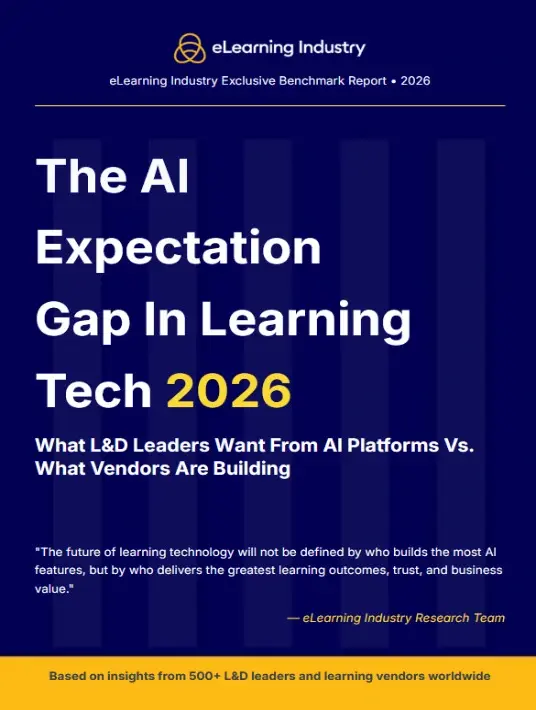
The AI Expectation Gap In Learning Tech 2026: What L&D Leaders Want From AI Platforms Vs. What Vendors Are Building
Learning About AI
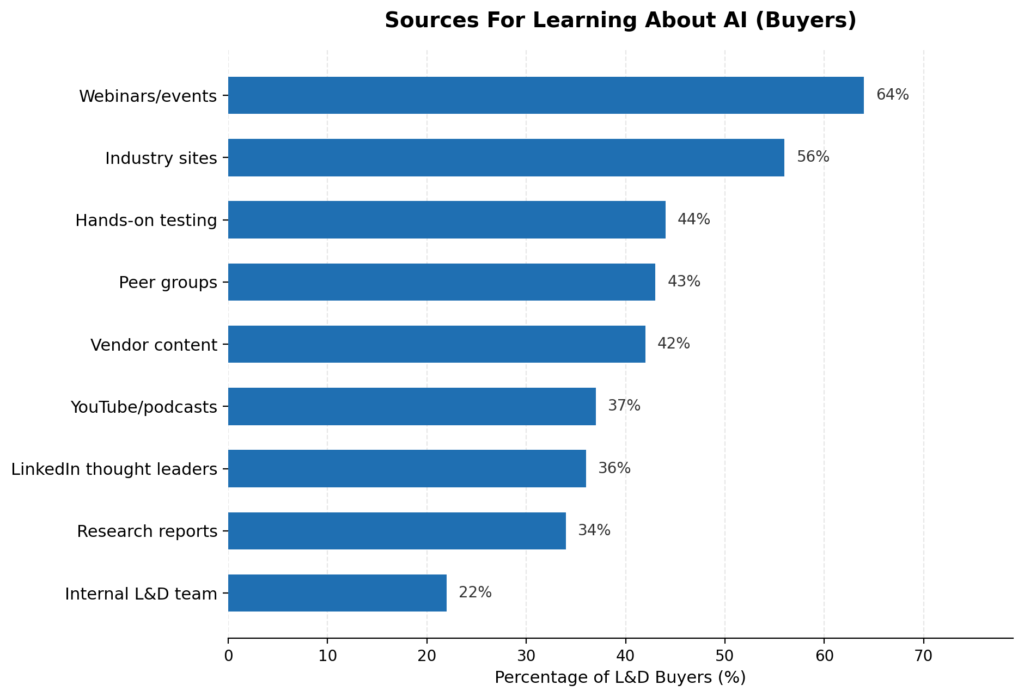
The channels buyers use to learn about AI reveal a strong preference for practical, experience-driven education.
Among buyers, webinars and events (64%) rank highest, followed by industry websites (56%). Hands-on testing (44%) and peer groups (43%) also play an important role, suggesting that many professionals prefer learning through experimentation and community discussion rather than vendor messaging alone.
Vendor content remains influential (42%), but buyers appear to balance provider information with independent sources and peer validation.
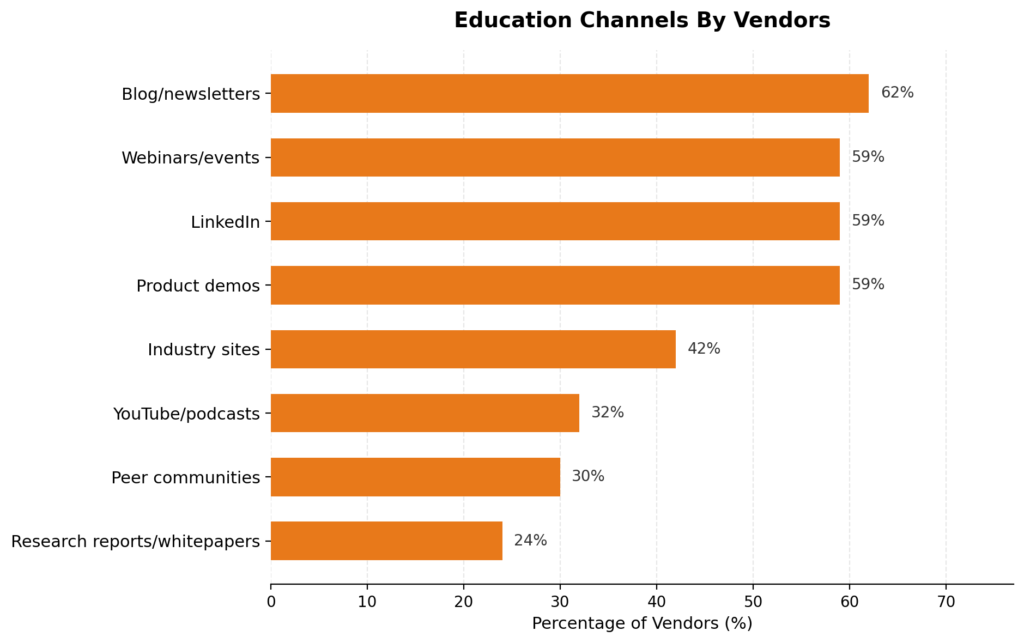 The vendor perspective tells a slightly different story. Providers rely heavily on blogs, newsletters, LinkedIn, product demonstrations, and webinars to educate prospective customers. These channels are more structured and content-driven, reflecting a deliberate effort to guide buyers through platform evaluation and AI adoption decisions.
Market Signal
Buyers primarily discover AI in L&D through webinars, industry publications, hands-on product evaluation, and peer communities. However, vendors tend to focus their AI education efforts on owned channels such as blogs, newsletters, LinkedIn, and product demos. This highlights a potential disconnect between where buyers actively seek information and where vendors invest most of their educational content and thought leadership efforts.
What Buyers Are Asking About AI, According To Vendors
The quantitative findings reveal what buyers value. Open-ended responses reveal what they are actively asking vendors. Analysis of vendor responses highlights several recurring themes in buyer inquiries regarding AI capabilities.
Most Common Buyer Requests About AI
- Automated content generation and course creation.
- Personalized learning experiences and adaptive learning paths.
- Data privacy and security protections.
- LMS integrations and technical compatibility.
- Cost, efficiency, and implementation impact.
The strongest demand centers around content creation and personalization. Buyers are actively seeking ways to reduce manual effort while simultaneously creating more tailored learning experiences.
Security and privacy concerns also appear consistently in vendor responses, reinforcing earlier findings around trust, governance, and responsible AI use.
Integration questions are particularly notable. Many buyers want to understand how AI capabilities fit within existing learning ecosystems rather than operate as standalone solutions.
Market Signal
Buyer conversations about AI are practical. Rather than focusing on futuristic capabilities, most inquiries revolve around implementation, integration, security, efficiency, and measurable outcomes. This reinforces a recurring theme throughout the report: buyers are evaluating AI through the lens of business value rather than novelty.
Preferred AI Training Formats
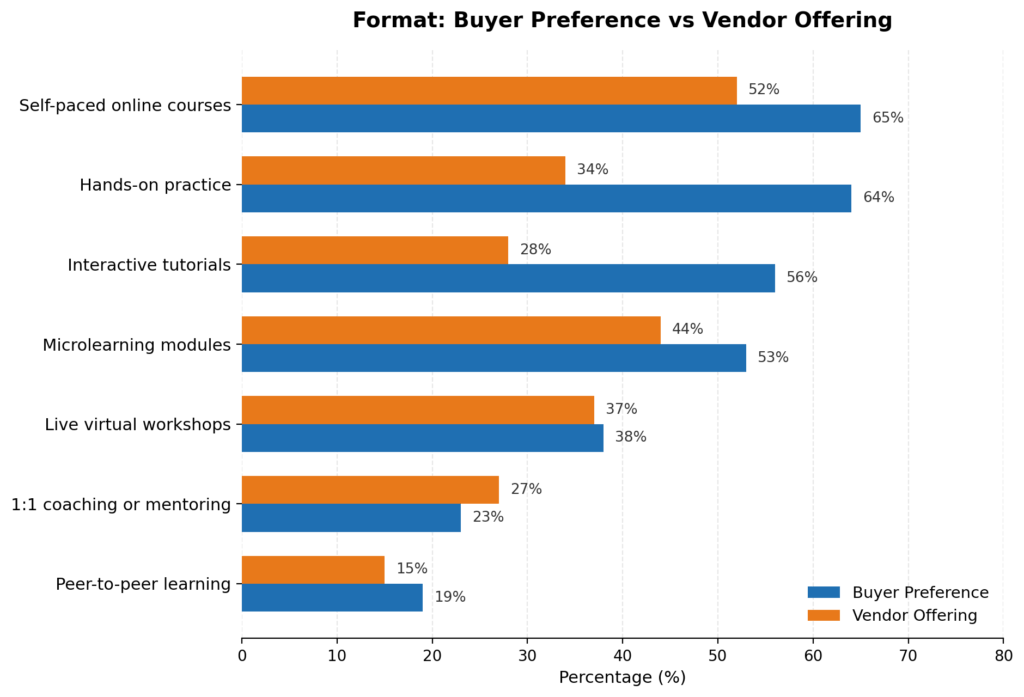
The preferred training formats reveal one of the clearest education-related gaps in the report.
Buyers overwhelmingly favor self-paced learning (65%) and hands-on practice (64%), followed closely by interactive tutorials (56%) and microlearning (53%). These preferences suggest a strong desire for practical, flexible, and experiential learning opportunities.
Vendor offerings only partially align with these expectations. While self-paced learning and microlearning remain common, significantly fewer providers report offering hands-on practice opportunities or interactive tutorials.
Live virtual workshops show the strongest alignment between the two groups, while coaching and peer learning remain secondary priorities.
Market Signal
The demand for practical AI learning currently exceeds supply. As organizations move toward implementation, hands-on experiences and interactive learning opportunities may become increasingly important differentiators.
Content Preferences And AI Value Demonstration
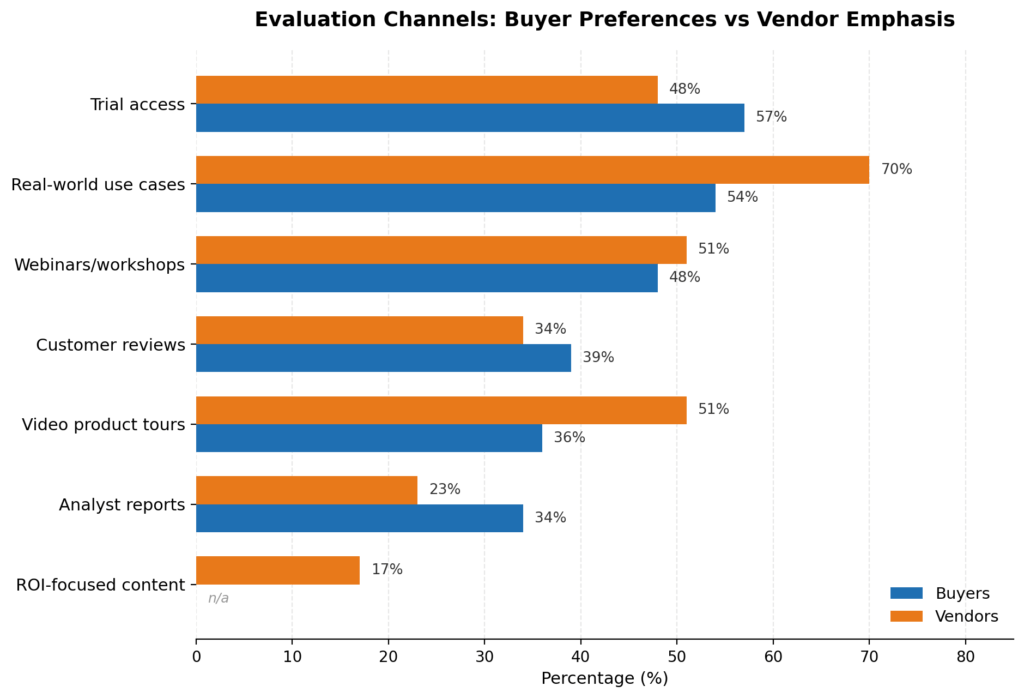
When evaluating new learning platforms and AI-powered solutions, buyers place the greatest value on trial access (57%), real-world use cases (54%), and webinars or workshops (48%). Customer reviews (39%), video product tours (36%), and analyst reports (34%) also play an important role in the evaluation process. Vendors largely align with these preferences by emphasizing use cases (70%), webinars (51%), video tours (51%), and trial access (48%) in their AI education efforts.
However, fewer vendors leverage customer reviews (34%), analyst reports (23%), or ROI-focused content (17%), despite buyers actively seeking these forms of validation during the purchasing process.
Market Signal
Buyers want practical proof that AI delivers value, with hands-on experiences and real-world examples carrying more weight than feature-focused messaging. Vendors that complement product education with stronger validation assets—such as customer evidence, independent comparisons, and measurable business outcomes—may be better positioned to build trust and accelerate buying decisions.
Investment And Pricing Perspectives
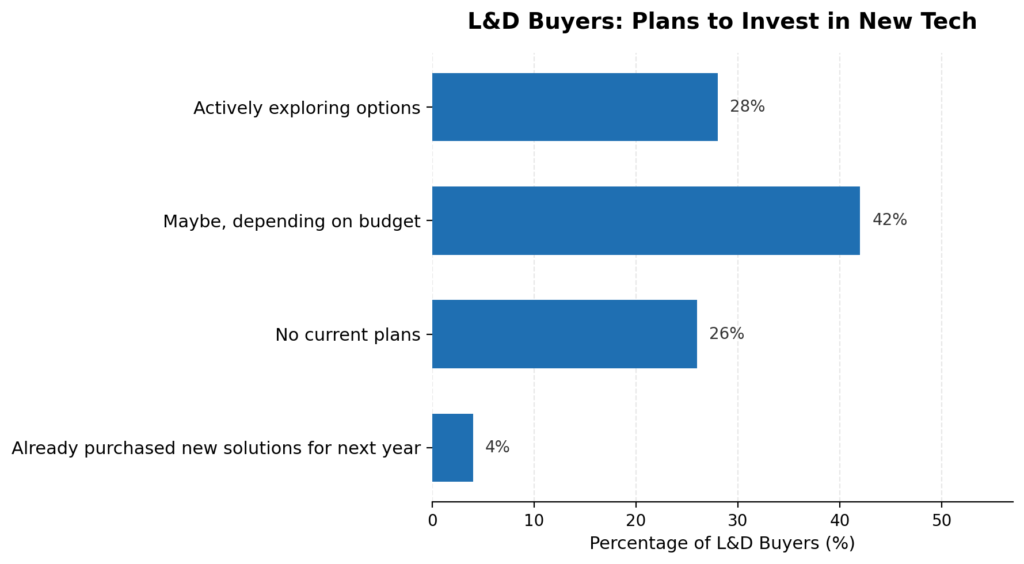
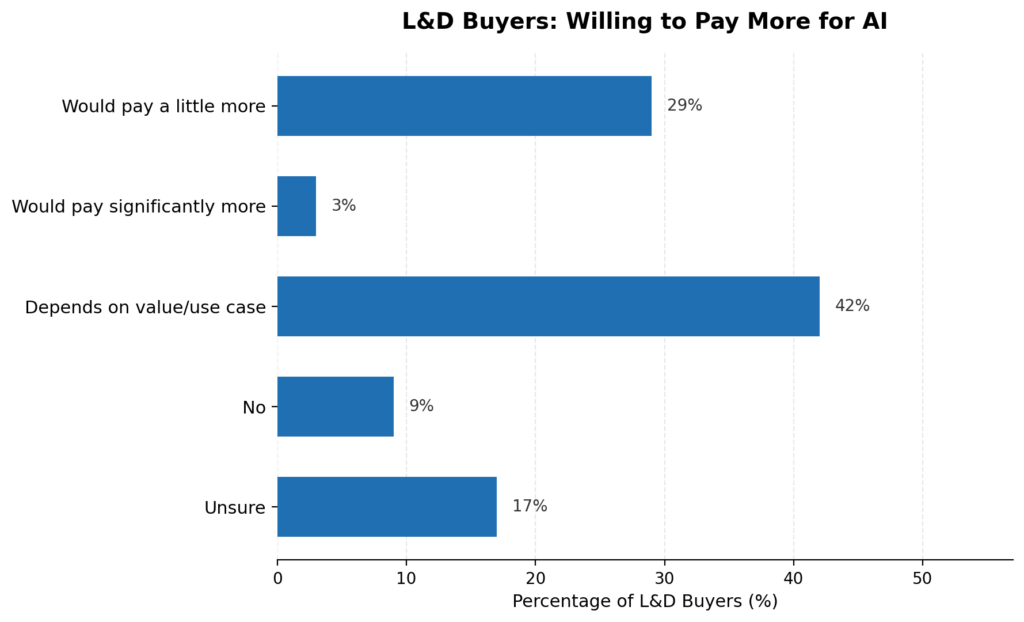
Investment sentiment reflects cautious optimism.
Buyer interest in AI-enabled learning technology is strong, but budget realities remain a significant factor. While 28% are actively exploring new technology investments, the largest segment (42%) indicates that purchasing decisions depend on available resources and demonstrated value.
The pricing data tells a similar story. Only 3% are willing to pay significantly more for AI capabilities, while the largest group (42%) ties willingness to pay directly to proven use cases and outcomes.
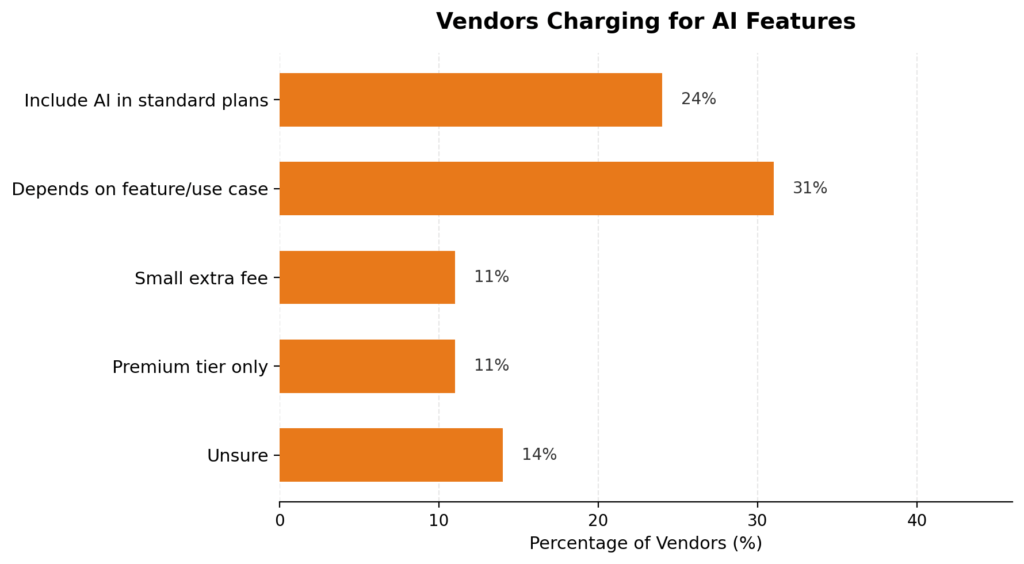
On the vendor side, pricing models remain fragmented. Some providers include AI within standard offerings, while others treat AI as a premium capability or use-case-based add-on.
Market Signal
The market has not yet established a dominant AI monetization model, and AI is not automatically a premium feature. Buyers appear willing to invest in AI, but only when the value is clear and measurable. Vendors may find it increasingly difficult to charge premiums for AI alone without demonstrating meaningful business impact.
Skills For The AI Era
The conversation around AI often focuses on technology. Yet our findings suggest that long-term success may depend just as much on people. These days, organizations are determining which skills, mindsets, and capabilities their teams will need to thrive in an AI-enabled workplace. The data reveals a workforce that is actively preparing for change, but one that is still in the early stages.
How L&D Teams Are Preparing For AI
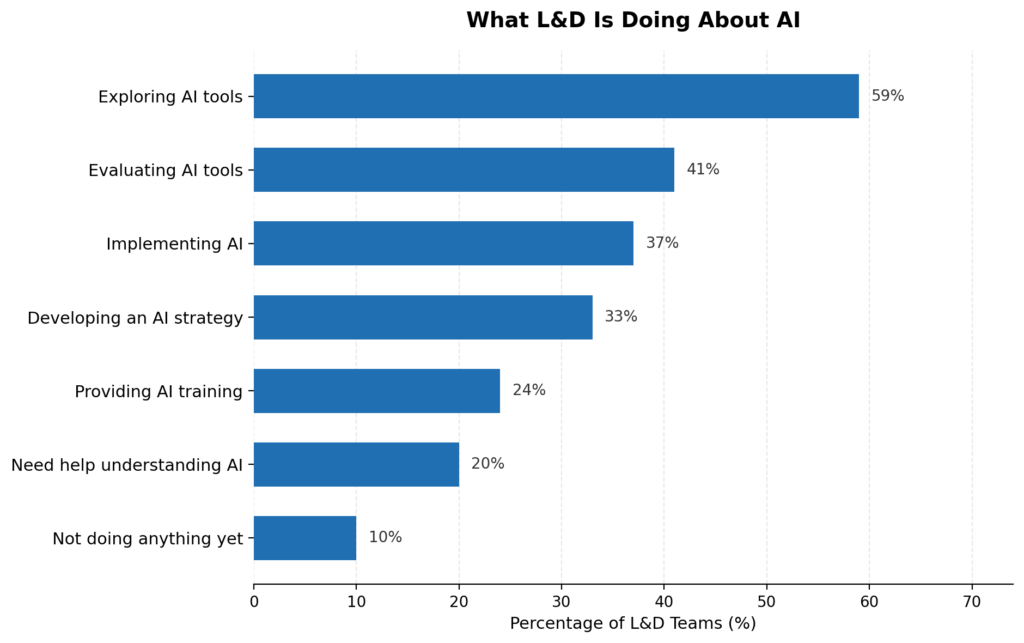
The survey results suggest that most Learning and Development teams are approaching AI with curiosity and cautious experimentation.
A majority of respondents (59%) report actively exploring AI tools, making it the most common activity across the sample. Meanwhile, 41% are evaluating AI tools, and 33% are developing formal AI strategies.
Implementation remains less widespread. Only 37% report actively implementing AI, while 24% are providing AI-related training within their organizations. At the same time, notable readiness gaps remain. One in five respondents indicates they still need help understanding AI, and 10% report taking no action so far.
Taken together, these findings suggest that many organizations are currently transitioning from awareness to action.
The Skills That Matter Most In The AI Era
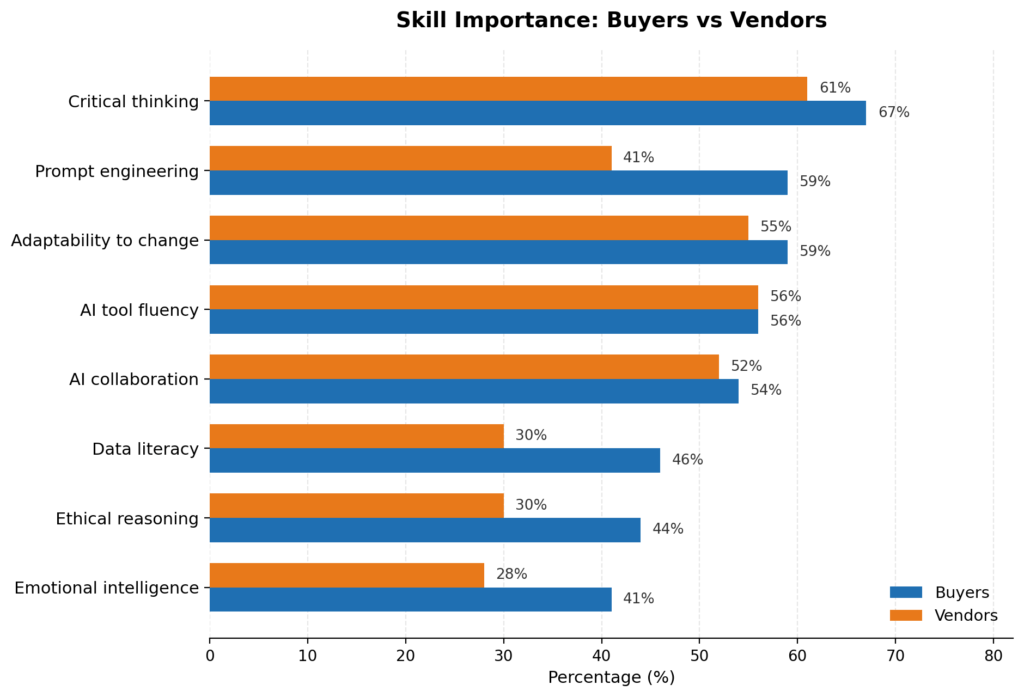
Despite widespread discussion around technical AI skills, the findings reveal that organizations are prioritizing a blend of human and technical capabilities.
Critical thinking emerges as the most important skill across both audiences, selected by 67% of buyers and 61% of vendors. Adaptability follows closely, reflecting recognition that AI will continue reshaping workflows, roles, and learning environments.
Both groups also place strong emphasis on AI tool fluency and AI collaboration, highlighting the growing expectation that professionals will work alongside AI systems rather than simply use them occasionally.
The highest-ranked skills are not purely technical. Organizations increasingly recognize that success depends on combining technology proficiency with judgment, adaptability, and decision-making capabilities.
Emerging Differences In Skill Priorities
While both groups generally agree on the skills that matter most, several notable differences emerge.
Buyers place considerably greater emphasis on prompt engineering (59% versus 41%), suggesting stronger interest in practical day-to-day interaction with AI systems. Similarly, data literacy, ethical reasoning, and emotional intelligence receive significantly higher scores among buyers than among vendors.
These differences may reflect the realities of implementation. Learning professionals are increasingly confronting questions about responsible AI use, information quality, governance, and human oversight as they begin integrating AI into workflows and learning programs. Meanwhile, vendors appear more focused on broad AI adoption and operational effectiveness.
Market Signal
As AI capabilities become more accessible, competitive advantage may shift away from technical expertise alone. Organizations should combine AI fluency with strong critical thinking, ethical judgment, adaptability, and human-centered leadership.
The Human Side Of AI Adoption
One of the most consistent themes throughout the report is that AI adoption is increasing, not reducing the importance of human skills.
Earlier sections revealed that buyers value transparency, control, trust, and meaningful learning outcomes. Open-ended survey responses also emphasized the importance of human oversight, quality assurance, and preserving human-centered learning experiences.
The skills findings reinforce this message. Even as AI becomes more capable, respondents continue to prioritize uniquely human strengths such as critical thinking, adaptability, ethical reasoning, and emotional intelligence.
Market Signal
The future of learning technology is unlikely to be defined by AI alone. For both buyers and vendors, preparing for the future will require investment not only in AI technology, but also in the people who use it.
Get Your Free Copy
Interested in learning more to prepare for the AI era? Download The AI Expectation Gap In Learning Tech 2026: What L&D Leaders Want From AI Platforms Vs. What Vendors Are Building, eLearning Industry's exclusive industry benchmark report. Learn everything other L&D pros are doing, and get a peek into your competitors' next moves.