



500+ L&D Buyers And Vendors Share Learning Tech Market Insights
Artificial Intelligence has become one of the most influential forces shaping the future of learning technology. Across the Learning and Development (L&D) landscape, organizations are evaluating how AI can improve learning experiences, increase efficiency, personalize training, and support workforce development at scale. But as AI adoption accelerates, a critical question emerges: Are learning technology vendors building the AI capabilities that buyers actually want?
The conversation around AI in learning platforms has largely focused on innovation. Vendors are introducing features such as automated content generation, AI-powered coaching, predictive analytics, and workflow automation at an unprecedented pace. At the same time, L&D leaders are becoming increasingly selective about where and how AI is applied, focusing less on novelty and more on measurable business value, learner outcomes, trust, and usability. As AI capabilities become more widely available across the market, organizations are increasingly evaluating not only what AI can do but also how effectively it can deliver meaningful outcomes, integrate into existing workflows, and support responsible adoption.
This dynamic has created what we call an emerging expectation gap between buyers and vendors. On one side, learning tech providers are investing heavily in AI development to remain competitive in a rapidly shifting market. On the other, buyers are evaluating whether these capabilities solve real problems, improve learning effectiveness, and justify additional investment.
Understanding where these priorities align (and where they diverge) has become increasingly important for both audiences. Let's see the current state of the learning solutions landscape through exclusive data collected by eLearning Industry from 500+ active L&D decision-makers, influencers, practitioners, and learning professionals, as well as learning technology providers serving the L&D market.

The AI Expectation Gap In Learning Tech 2026: What L&D Leaders Want From AI Platforms Vs. What Vendors Are Building
The Learning Solutions Landscape
The learning technology market is shaped by changing learner expectations, increasing platform specialization, and growing interest in AI-enabled capabilities. Yet despite the pace of innovation, the findings suggest that buyers remain focused on fundamentals.
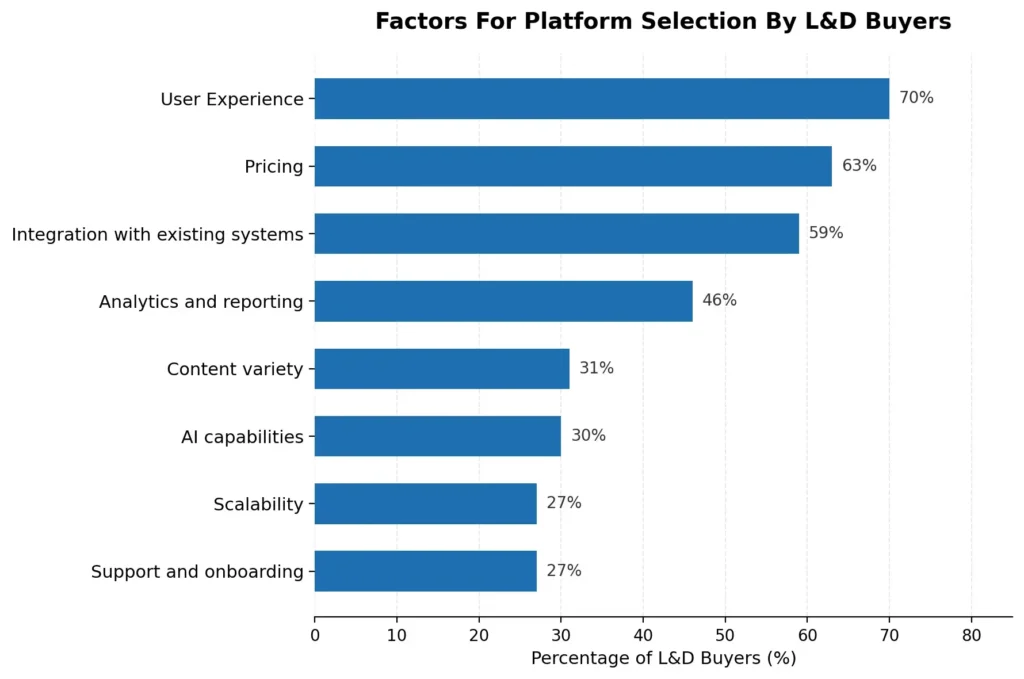
Platform selection factors (L&D buyers).
When evaluating learning platforms, buyers consistently prioritize practical considerations over emerging technologies. User Experience leads all buying criteria at 70%, followed by pricing (63%) and integration capabilities (59%). Analytics and reporting (46%), content variety (31%), and AI features (30%) also influence decision-making, though to a lesser degree. Scalability and onboarding support remain important but are not primary selection drivers, each cited by 27% of respondents.
These findings reinforce a recurring theme throughout eLearning Industry's report: buyers continue to evaluate learning technology through the lens of usability, value, and operational fit, while vendors design for innovation and future demand.
Before examining which platform types dominate the market, it is worth understanding how buyers and vendors view satisfaction with current learning platforms.
Satisfaction With Current Learning Platforms
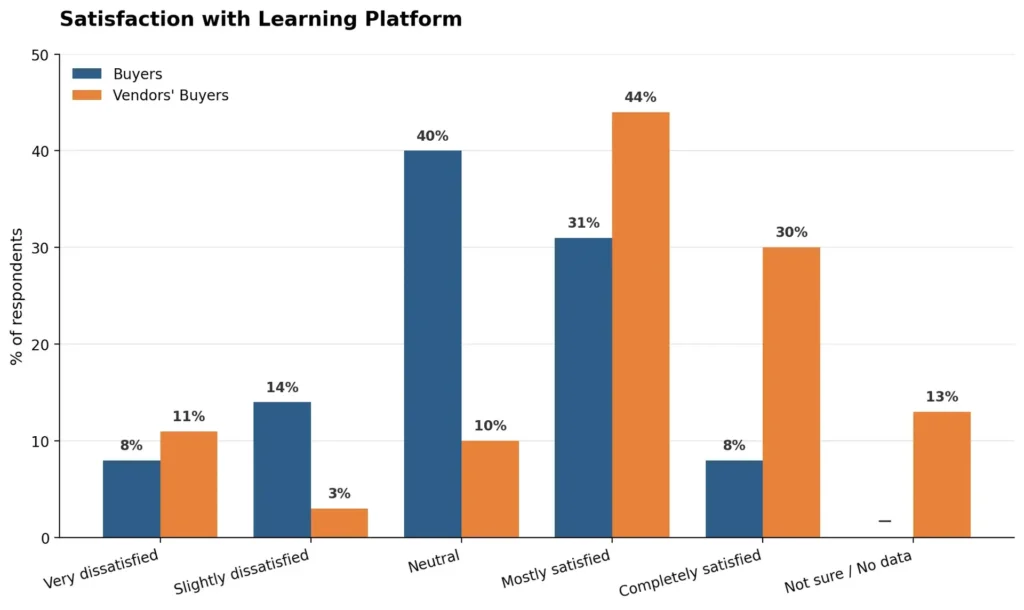
Satisfaction with learning platforms.
Buyers report mixed satisfaction with their current learning platforms. The largest group (40%) remains neutral, while only 8% describe themselves as completely satisfied. At the same time, 22% report some level of dissatisfaction, suggesting there is considerable room for improvement across the market.
In contrast, vendors perceive significantly higher satisfaction among their client base. According to providers, 44% of customers are mostly satisfied, and 30% are completely satisfied. Only 3% report dissatisfied customers, while 13% indicate they do not have sufficient data to assess client satisfaction accurately.
What Does This Mean For The Learning Tech Market?
The learning platform market may be experiencing a perception gap. While vendors generally believe customers are satisfied, buyer responses indicate more ambivalence and unmet expectations. This disconnect suggests an opportunity for providers to deepen customer feedback loops, improve platform usability, and better understand the day-to-day challenges facing learners and administrators.
The findings also provide important context for the platform adoption trends explored below. If buyers are not overwhelmingly satisfied with their current solutions, emerging technologies and platform categories have greater potential to gain traction, but only if they solve meaningful problems.
So, which platforms are buyers using today, and how closely do vendor offerings align with that demand?
Platform Types
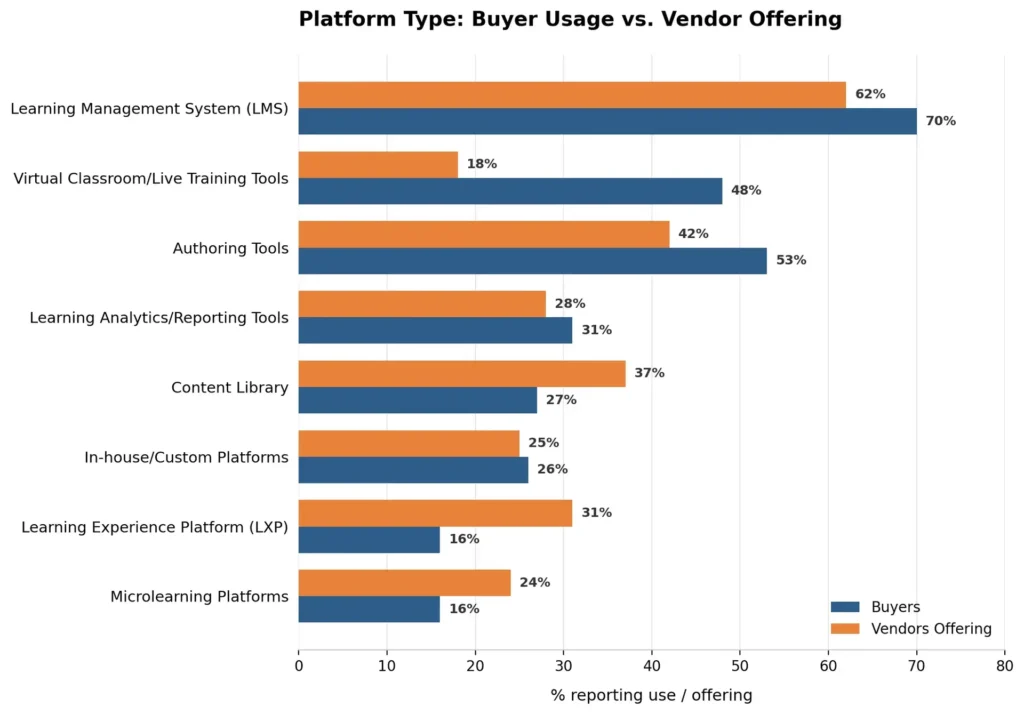
Platform types (Buyer Usage vs. Vendor Offering)
Despite continuous innovation in AI-powered learning technologies, the Learning Management System (LMS) remains the foundation of the learning ecosystem. It is the most widely used platform type among buyers and the most commonly offered solution among vendors, reinforcing its role as the primary hub for delivering, managing, and measuring learning experiences.
Beyond the LMS, however, the data reveals several notable areas of divergence.
The most significant gap appears in virtual classrooms and live training tools. Nearly half of buyers (48%) report using these solutions, compared with only 18% of vendors that currently emphasize them within their offerings. This suggests that while providers continue investing in scalable and asynchronous learning experiences, buyers still place substantial value on instructor-led learning, collaboration, and real-time interaction.
A similar gap emerges around Learning Experience Platforms (LXPs). While 31% of vendors report offering LXP capabilities, only 16% of buyers report using them. Vendors have spent years positioning LXPs as the next evolution of workplace learning, yet buyer adoption appears to be developing more slowly than vendor investment.
What Does This Mean For The Learning Tech Market?
The data suggests that buyers and vendors are not always prioritizing the same platform experiences.
Vendors appear to be investing ahead of demand in areas such as LXPs and AI-enabled capabilities, while buyers continue to rely heavily on proven solutions that support immediate operational needs. At the same time, strong adoption of virtual and live learning tools highlights the continued importance of human interaction within digital learning environments.
Ultimately, successful platform strategies may require balancing future-focused innovation with the practical realities of how learning is delivered today. Vendors that position AI and emerging technologies as complementary enhancements rather than complete replacements may be better aligned with current buyer behavior.
Get Your Free Copy
Interested in learning more data from the learning tech market? Download The AI Expectation Gap In Learning Tech 2026: What L&D Leaders Want From AI Platforms Vs. What Vendors Are Building, eLearning Industry's exclusive industry benchmark report. Learn everything other L&D pros are doing, and get a peek into your competitors' next moves.