





The Answer Isn't Talent, Effort, Or Job Title
I've spent more than twenty years working with learning leaders across some of the world's largest organisations, and one observation has stayed with me throughout.
Two people. Same job title. Same budget conversation. Same pressure to prove value. But when I sat with one, the conversation was about skills frameworks, career pathways and succession. When I sat with the other, it was about revenue, conversion rates and how fast we could get people performing.
For a long time, that contrast confused me. Eventually, I realised the answer had been hiding in plain sight.
Who you report to defines what value means.
The central CLO reporting into an HR Director is being asked, implicitly or explicitly, how learning is helping people feel developed. How it's supporting succession. How it's building the skills the organisation will need in three years' time.
The functional learning leader embedded in a sales, retail or customer service operation is being asked something very different. Are my people performing better? Can we move average performers closer to our best? Can we get people competent faster when we launch a new product or promotion?
Same profession. Same passion. Radically different definitions of success. And once I truly saw that, something else became clear: we don't just have a reporting structure problem. We have a lens problem.
The Two Lenses Every Learning Leader Needs
At the heart of almost every conversation about learning value, there are two fundamentally different questions being asked.
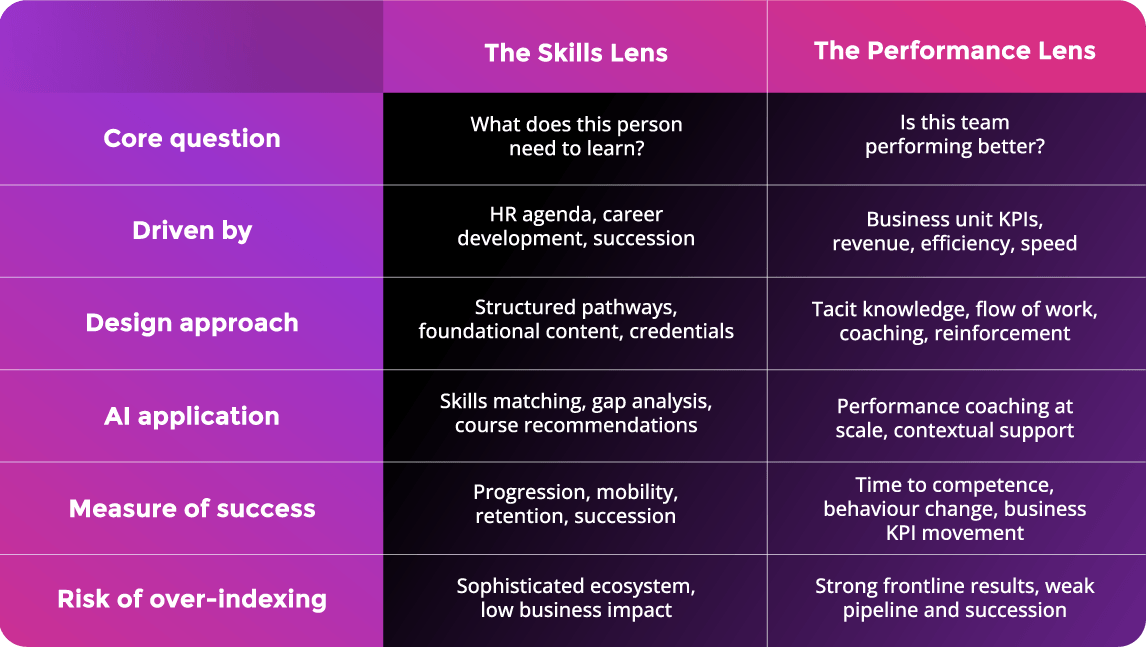
The Skills Lens asks: What does this person need to learn? What's the gap between where they are and where they need to be? How do we build that foundation, and how do we develop this individual towards what comes next?
The Performance Lens asks: Is this team performing at the level the business needs? Are we moving average performers closer to our best? Are people executing correctly—not just knowledgeable, but actually doing it right, consistently, in the moment?
Both are the right questions. Both create genuine value. But designing for skills and designing for performance are not the same undertaking. They require different thinking, different approaches, different technology, and very different measures of success. The differences break down like this:
The 50kg Backpack Problem
This is where the distinction becomes practical.
When you're designing for skills, a certain toolbox makes perfect sense: skills gap analysis, foundational content libraries, career architecture, structured learning pathways, credentials and certifications, technology that helps individuals understand where they are and map a route to where they want to be. All of it is valuable. All of it is coherent through that lens.
But now imagine you're the learning leader for a retailer, a car manufacturer, a hospitality business or a customer service operation. Your frontline people don't have time for a structured learning journey. They need to be competent now. They need the right knowledge at the moment they need it, and they need to keep getting better as products change, promotions launch and customer expectations shift.
The instinct is to load people up front: to give them everything they might need, a 50kg backpack of knowledge before they even start. The smarter approach is to give them a 5kg backpack, and then make the job itself the classroom.

Research has long told us that learning in the flow of work dramatically outperforms front-loaded training that decays the moment someone walks away from it. The question isn't just what do we train people on. It's what do we stop training people on upfront, and instead make available at the moment of need. That's a radically different design challenge, and it needs a radically different toolbox.
For the performance lens, the capabilities that actually move the dial look more like this: capturing the tacit knowledge of your highest performers and making it accessible to everyone; keeping knowledge continuously current as products, processes and promotions change; mobile-first, instant-access performance support; social learning between people actually doing the job; practice, reinforcement and coaching against what great looks like.
The two toolboxes overlap—perhaps 30% is shared—but the differences are bigger than the similarities. And those differences are often exactly where the performance value gets created, or lost.
What The Best Organisations Already Know
This isn't theory. The organisations that have cracked this are doing something distinctive, and the results speak for themselves.
Hilti has one of the purest approaches to the performance lens I've ever seen. If their learning team cannot identify a clear line between a proposed programme and a measurable business KPI, the recommendation is simply not to build it. Not to pause. Not to revisit. Not to invest. That discipline sounds extreme until you see what it produces: a learning function that has earned the trust and the budget of the business, because every programme it runs has a reason to exist.
Veidec's learning programme helped drive 13.5% combined revenue growth across its core markets in Sweden and Denmark, with total sales up 19% in Denmark alone. Panasonic tracked measurable improvements in CSAT scores and retention. Carpetright built a learning experience so embedded in the flow of work that it generates 10,000 content views a day, every day; when Lynn Moran led learning there, the conversation with the business wasn't about learning metrics, it was about average order value, and when the programme moved that number, it didn't just justify the technology, it justified the entire learning function.
But the skills lens creates real value too. When Levy invested in a General Manager development programme, it produced a 15% increase in their TNPS score. That connects directly to retention, and retention has a very real commercial cost. That is a business outcome—it's just measured differently. The lens is different. The value is no less real.
Both lenses matter. The mistake is thinking only one does.
The Moment That Changed How I Think About This
Of all the results I've seen over twenty years, one has stayed with me more than almost any other.
We worked with a large retailer to bottle the greatness of their best people. We captured the tacit knowledge of their highest performers: the things they knew intuitively, the judgements they'd developed from thousands of customer interactions, the small things they did differently that nobody had ever written down. We then turned it into accessible, bite-sized content that everyone could learn from.
The impact was real: performance improved by around 10%. But that uplift began to decay, because even brilliant, expert content can only take a team so far.
What made one store perform 40% higher than the others wasn't the content. It was the performance coaching: managers who used that high-performer knowledge as a reference point, who could sit with an individual, understand exactly where they were struggling and help them close the gap, who could move someone from a 5 to a 7, and then from a 7 to a 9.
The content created the foundation. The coaching created the transformation. The problem has always been scale: exceptional coaching is human, human time is finite, and you can't replicate a great manager across thousands of people in hundreds of locations.
Until now.
This is where AI gets genuinely exciting. Not the AI that creates a course in 30 seconds, useful as that is, but the AI that can understand the individual, remember what they've learned, know where they're struggling, understand what great performance looks like, retrieve the right expert knowledge, create opportunities to practise, give feedback, coach, and adapt what happens next.
Through the skills lens, AI is a smarter way to match people to content and map their development journey. Valuable, but ultimately a faster version of something we already knew how to do. Through the performance lens, AI has the potential to scale the 40% moment—to make personalised performance coaching available to everyone, not just the people lucky enough to have an exceptional manager. The economics of that are starting to change, and with them, so does the potential value learning can create.
The Question Before The Question
One habit, in my experience, gets learning leaders into trouble more than any other. The value question gets asked after the programme has been designed, built and rolled out—the time, budget and energy already spent—and only then does someone ask whether it was worth it.
The smartest organisations ask that question first: what value are we trying to create, for whom, and measured how?
Is this a skills programme, designed to develop an individual towards something they aren't doing today? Then the metrics should reflect that: progression, internal mobility, readiness, retention.
Is this a performance programme, designed to help a team perform better at what they're doing right now? Then measure accordingly: time to competence, behaviour change, knowledge currency, and ultimately, movement on the business KPI that matters to the leader who owns that audience.
Is it compliance? Then be honest about what value actually looks like there. In many cases it's risk mitigation; the cost of the programme weighed against the cost of something going wrong. That's a legitimate value equation. It just isn't a performance one.
The definition of value should follow the problem you're solving, not the technology you already own.
The Honest Challenge For Learning Leaders
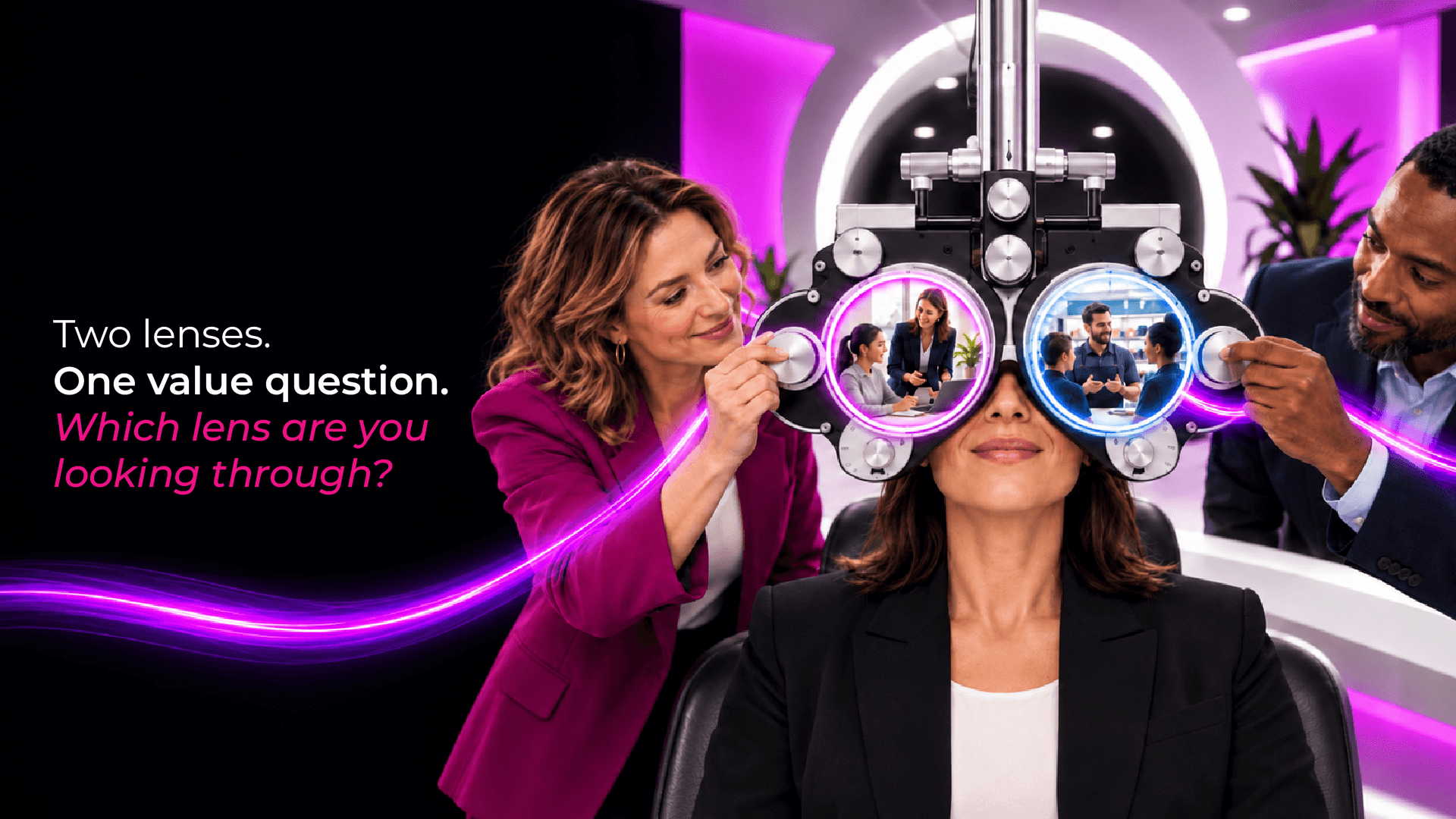
If you're a learning leader reading this, it's worth sitting with a single question: which lens are you naturally strongest in, and which lens is your organisation currently rewarding you for?
Most learning functions have a dominant lens, usually shaped by who sits above them in the organisation. That's not failure—it's the reality of the structure you're operating in. But awareness of the other lens is the first step towards something more complete.
In organisations where 90% of the workforce is frontline—hospitality, retail, manufacturing, customer service—the performance lens isn't optional. If that 90% performs, the business wins, and a learning function that can demonstrably move that dial doesn't just justify its technology, it justifies its entire existence.
At the same time, the skills lens matters too. People want to feel they have a future. Organisations need succession. A learning function that only ever talks about this quarter's KPIs will eventually lose the people it's trying to develop.
The most complete answer to the value question, both today and in the future, comes from learning leaders who can see through both lenses clearly—who understand which one applies to which programme, which stakeholder and which moment. Who can speak fluently in the language of skills development with their HR director, and equally fluently in the language of business performance with their Sales or Operations director.
That's not easy. It requires different thinking, different design, and a willingness to challenge the bias that your reporting line quietly creates. But it's the difference between a learning function that's always defending its value, and one that never has to.
Which lens are you looking through, and what might you be missing?
Steve Dineen is Founder and CEO of Fuse, the LMS for the AI era, and creator of Lyra, Fuse's AI performance coach and thinking partner.
All images provided by Fuse Creative Agency.